£295 single volume · £995/yr annual · Team £2,495 · Enterprise £4,995 · Corporate £9,995. Secure checkout coming soon; email to purchase today.
GridteamAI · Quarterly Sector Report · Gap 47 · CATALOGUE CLOSE
UK Gas Market Reform — the five-component reform agenda for a declining-demand gas market, cross-utility regulatory coordination, and the close of the 47-volume catalogue · Gas beachhead
Series consistency · canonical Gap-series system
A4 · 210 × 297 mm · 3 mm bleed (not shown)
UK English · ~30 pp · v2.1 / Q3 2032
The first structural reform of a UK market in retreat — wholesale, retail, capacity and hydrogen, coordinated across utilities. The volume that closes the 47-report catalogue.
gridteamai.com · book@gridteamai.comv2.1 · Q3 2032Gas · Catalogue close
05 — 06Executive summary · spread
UK Gas Market Reform · Executive summary05
00 · Executive SummaryA two-page brief
Five reform components, one declining market, whole-system coordination.
UK gas-market reform is the first structural reform of a UK energy market in sustained decline. As heat decarbonises and gas demand falls, the wholesale, retail and capacity markets must be redesigned to allocate a shrinking system’s costs fairly — a different problem from reform during growth.
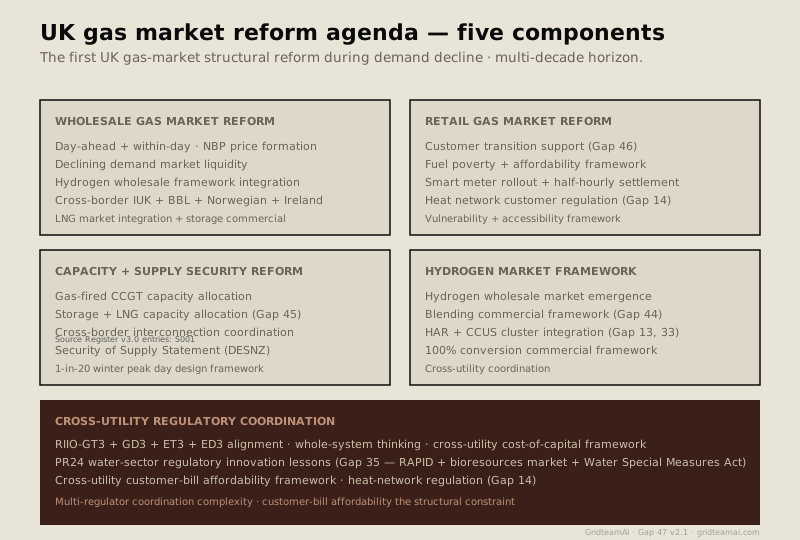
The agenda has five components: wholesale (declining-demand liquidity, the hydrogen framework, cross-border and LNG integration); retail (customer transition, fuel poverty, smart metering, heat-network regulation); capacity and supply security (CCGT, storage and LNG allocation, the 1-in-20 design); the hydrogen wholesale framework; and cross-utility regulatory coordination.
The binding theme is cross-utility coordination: aligning the RIIO-GT3/GD3/ET3/ED3 price controls, applying the PR24 water-sector innovations (Gap 35), integrating heat-network regulation (Gap 14), and holding whole-system customer-bill affordability across gas, electricity, water and heat.
Reform during decline is a different discipline from reform during growth.
When a market grows, reform allocates new capacity and new revenue. When it declines, reform allocates falling throughput, stranded-asset cost and a shrinking customer base — against a hard customer-bill affordability ceiling and a fuel-poverty constraint. The UK has a live precedent to draw on: the PR24 water determinations (Gap 35) showed how to gate investment, run a bioresources market and enforce performance, and those lessons transfer directly to gas.
The Q3 2032 picture
Wholesale-market reform is accommodating declining liquidity and an emerging hydrogen framework; retail reform has strengthened customer-transition and heat-network protection; the capacity and supply-security markets are re-calibrated for a smaller gas fleet; and cross-utility coordination across the RIIO and Ofwat frameworks is the operative discipline — the close of the 47-volume catalogue.
The shape of this volume. Section 1 sets out the headline figures. Section 2 develops twelve findings, each confidence-annotated. A chapter-weight pull at p. 14 anchors the argument. Section 3 sets out the five reform components. Section 4 covers cross-utility coordination and the PR24 lessons. Section 5 covers the risks, the outlook and the catalogue close. Section 6 makes recommendations, with a one-page tear-out at p. 25.
Executive summary · ends1 · The headline figures · p. 07
09 · FIG. 11 · The five reform components · restyled -v2
1 · The headline figures09
Figure 1 · The five reform componentsWholesale · retail · capacity · H2 · cross-utility
The gas-market reform agenda, in five components.
Wholesale (declining-demand liquidity, the hydrogen framework, cross-border + LNG); retail (customer transition, fuel poverty, smart metering, heat-network regulation); capacity + supply security (CCGT, storage, LNG, the 1-in-20 design); the hydrogen market framework; and cross-utility regulatory coordination — the binding theme.
Fig. 1 / Section 1
The cross-utility band (umber) is the binding theme. Reform during decline is about fair cost allocation, not new capacity.
Quarterly Sector Report · Gap 472 · Twelve findings · p. 10
09 — 102 · Six findings · 01 – 04 · 2×2 grid
2 · Twelve findings on gas-market reform10
2 · Twelve findings on gas-market reformQ3 2032
Twelve findings. Each carries a confidence level.
HIGH — anchored to a verified DESNZ position. MEDIUM — named industry coverage with credible methodology. LOW — GridteamAI projection where the source supports direction but not magnitude.
Findings 01 – 12 · summary
01This is the first UK gas-market structural reform during sustained demand decline.
02Wholesale-market reform must manage declining liquidity and an emerging hydrogen framework.
03Retail reform centres on customer transition, fuel poverty and heat-network regulation.
04Capacity and supply-security reform recalibrate for a smaller gas-fired fleet.
05A hydrogen wholesale market framework is emerging alongside the gas one.
06Cross-utility regulatory coordination is the binding theme of the whole agenda.
07The four RIIO price controls (GT3, GD3, ET3, ED3) must be aligned whole-system.
08The PR24 water determinations are the live cross-utility reform precedent (Gap 35).
09Customer-bill affordability is the structural constraint across all four utilities.
10Declining wholesale liquidity raises cross-border-integration and price-formation risk.
11The reform closes the Gas beachhead and the entire 47-volume catalogue.
12Implications for DESNZ, Ofgem, HM Treasury, the networks and customers.
Findings 01 – 09 follow in detail · pp. 10 – 12 · 10 – 12 summarised on the matrix
This is the first UK gas-market structural reform during sustained demand decline.
UK gas-market reform is the regulatory and commercial agenda required to accommodate declining gas demand (Gap 43), network repurposing (Gap 44), storage and supply-security evolution (Gap 45) and heat decarbonisation (Gap 46). It is the first structural reform of a UK energy market during sustained demand decline — a fundamentally different problem from reform during growth. When a market grows, reform allocates new capacity and revenue; when it declines, reform must allocate falling throughput, stranded-asset cost and a shrinking customer base, against a hard customer-bill affordability ceiling. Five components span the agenda: wholesale, retail, capacity and supply security, the hydrogen market framework, and cross-utility regulatory coordination.
Finding 02 · HIGH
Wholesale-market reform must manage declining liquidity and an emerging hydrogen framework.
The UK wholesale gas market — day-ahead and within-day trading, long-term Norwegian and LNG contracts, cross-border interconnection and hub-based price formation at the National Balancing Point (NBP) — faces reform on several fronts as demand falls. Market liquidity reduces as throughput declines, raising price-formation and cross-border-integration risk. A hydrogen wholesale framework must emerge alongside the gas one — a blending commercial framework first, a hydrogen-only market after conversion — integrating HAR contracts (Gap 13) and CCUS-cluster pricing (Gap 33). And capacity allocation at the NGT system, storage, LNG and interconnectors must be re-calibrated for declining throughput. The wholesale market built for a growing gas system has to be redesigned for a contracting one.
Finding 03 · HIGH
Retail reform centres on customer transition, fuel poverty and heat-network regulation.
Retail gas-market reform centres on the customer. As households move off gas (Gap 46), the retail framework — dual-fuel suppliers, the Ofgem price cap, smart metering, switching and the vulnerability framework — must support the transition (the Boiler Upgrade Scheme, green-home and local-authority financing, the supplier customer journey) and hold the fuel-poverty line (Cold Weather Payment, Warm Home Discount, ECO, and the electricity-to-gas spark spread that determines running costs). A new regulated domain is heat-network customer regulation (Gap 14): Ofgem regulation of heat-network supply, a tariff framework and consumer protection, and the single-supplier-monopoly question within a designated zone. Completing the smart-meter rollout and half-hourly settlement underpins cross-utility customer data and vulnerability identification.
 GridteamAI