£295 single volume · £995/yr annual · Team £2,495 · Enterprise £4,995 · Corporate £9,995. Secure checkout coming soon; email to purchase today.
GridteamAI · Quarterly Sector Report · Gap 46 · GAS FLAGSHIP
UK Heat Decarbonisation + Gas Grid Exit — ~28 million homes, ~85% gas-heated; the four pathways, the gas-grid-exit map and the largest single UK consumer-facing energy transition · Gas flagship
Series consistency · canonical Gap-series system
A4 · 210 × 297 mm · 3 mm bleed (not shown)
UK English · ~30 pp · v2.1 / Q2 2032
The largest single UK consumer-facing energy transition — ~85% of homes gas-heated, four decarbonisation pathways, and the gas-grid-exit map that follows. The Tranche 2 Gas flagship.
UK Heat Decarbonisation + Gas Grid Exit · Executive summary05
00 · Executive SummaryA two-page brief
Twenty-eight million homes, four pathways, one transition.
Around 28 million UK homes, ~85% gas-heated, must change how they are warmed. Heat is ~1/3 of final energy demand and ~1/4 of emissions; winter peak heat demand exceeds peak electricity demand by ~3–4×. This is the largest single UK consumer-facing energy transition.
Four pathways decarbonise it: heat pumps (Boiler Upgrade Scheme, Clean Heat Market Mechanism; ~55–60k installs/year scaling toward a 600k target); heat networks in dense urban areas (heat network zoning, Energy Act 2023); hydrogen in cluster regions (Gap 44); and building-fabric efficiency reducing total demand.
As customers leave gas heating, the gas grid exits region by region over a multi-decade horizon — raising the central stranded-asset question (Gap 43): how the cost of a declining-utilisation network is allocated across a shrinking customer base, equity, debt and contractor margins.
The transition is technically clear — the binding constraints are cost, pace and customers.
No pathway is optimal everywhere: heat pumps suit much of the suburban and rural stock; heat networks suit dense urban areas; hydrogen suits industrial clusters; fabric efficiency reduces demand across all of them. The hard problems are not technical but social and financial — heat-pump capital cost (£8–15k+), the electricity-to-gas spark spread, the installer-workforce scale-up, fuel-poverty exposure and the stranded-asset allocation.
The Q2 2032 picture
Heat-pump deployment is scaling against the 600k/year ambition; heat-network zones are being designated and built out under the Energy Act 2023 zoning regulations; the hydrogen-for-heat decision (Gap 44) has shaped the regional map; and the gas-grid-exit framework — phased regional designation with customer-transition and stranded-asset arrangements — is taking form under RIIO-GD3.
The shape of this volume. Section 1 sets out the headline figures. Section 2 develops twelve findings, each confidence-annotated. A chapter-weight pull at p. 14 anchors the argument. Section 3 sets out the four decarbonisation pathways. Section 4 covers gas grid exit, the regional map and customer affordability. Section 5 covers the policy framework, risks and the outlook. Section 6 makes recommendations, with a one-page tear-out at p. 25.
Executive summary · ends1 · The headline figures · p. 07
09 · FIG. 11 · UK heat scale + four pathways · restyled -v2
1 · The headline figures09
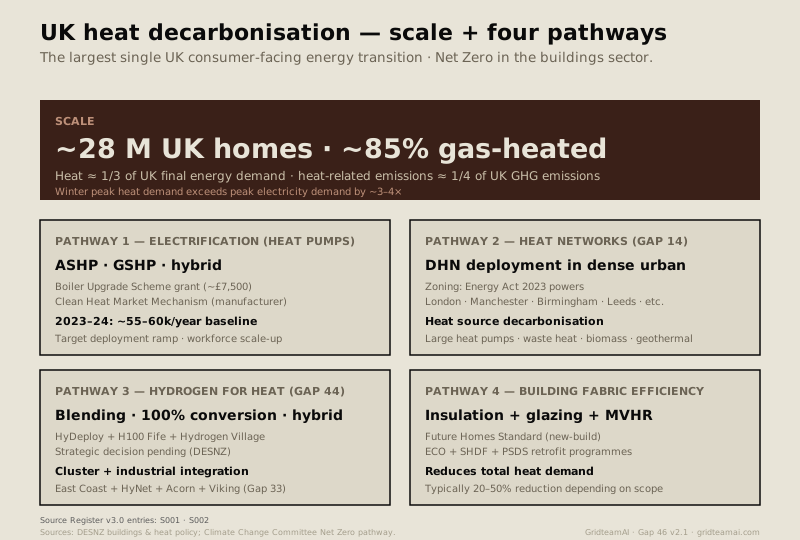
Figure 1 · UK heat scale + four pathways~28M homes · 4 pathways
The scale of UK heat, and the four pathways to decarbonise it.
~28 million homes, ~85% gas-heated; heat is ~1/3 of final energy and ~1/4 of emissions. Four pathways: electrification (heat pumps, BUS + CHMM), heat networks (heat network zoning, Energy Act 2023), hydrogen (Gap 44), and building-fabric efficiency (Future Homes Standard).
Fig. 1 / Section 1
The scale band (umber) frames the challenge. No single pathway is optimal everywhere — the answer is a regional mix.
Quarterly Sector Report · Gap 462 · Twelve findings · p. 10
09 — 102 · Six findings · 01 – 04 · 2×2 grid
2 · Twelve findings on heat decarbonisation10
2 · Twelve findings on heat decarbonisationQ2 2032
Twelve findings. Each carries a confidence level.
HIGH — anchored to a verified DESNZ position. MEDIUM — named industry coverage with credible methodology. LOW — GridteamAI projection where the source supports direction but not magnitude.
Findings 01 – 12 · summary
01~85% of UK homes are gas-heated — heat is ~1/4 of UK emissions.
02Heat pumps are the primary electrification pathway, gated by deployment rate.
03Heat-pump deployment runs an order of magnitude below the 600k/year ambition.
04Heat networks are the dense-urban pathway, with zoning powers in the Energy Act 2023 and the regulations still to be laid.
05Hydrogen for heat is the cluster-region pathway, pending the Gap 44 decision.
06Building-fabric efficiency reduces total heat demand across all pathways.
07Gas grid exit raises the central stranded-asset allocation question (Gap 43).
08The pathway map is regional — heat pump, heat network or hydrogen by geography.
09Customer affordability and the spark spread are the binding adoption constraints.
10The installer workforce (~50,000+) must scale to meet the deployment ambition.
12Implications for DESNZ, Ofgem, local authorities, the GDNs and customers.
Findings 01 – 09 follow in detail · pp. 10 – 12 · 10 – 12 summarised on the matrix
Quarterly Sector Report · Gap 462
112 · Findings 01 – 03
2 · Findings 01 — 03The scale · heat pumps · the deployment gap
Finding 01 · HIGH
~85% of UK homes are gas-heated — heat is ~1/4 of UK emissions.
The scale defines the problem. Around 28 million UK homes, ~85% of them, are heated by mains natural gas; a further ~10% use electric heating, ~4% off-grid oil, and ~1% LPG, biomass or heat networks. Heat is approximately a third of UK final energy demand and heat-related emissions are approximately a quarter of UK greenhouse-gas emissions, dominated by domestic heating. UK heat demand is also highly seasonal — winter peak versus summer minimum varies by ~10×, and winter peak-day heat demand exceeds peak electricity demand by ~3–4×. Any decarbonisation pathway must accommodate that peak profile. This is why heat is the largest single UK consumer-facing energy transition.
Finding 02 · HIGH
Heat pumps are the primary electrification pathway, gated by deployment rate.
Heat pumps — air source (ASHP, most common), ground source (GSHP, higher efficiency, needs land), hybrid (with a gas boiler for peak) and water source — are the primary electrification pathway. The policy framework is the Boiler Upgrade Scheme (a DESNZ installation grant of ~£7,500 for air or ground source) and the Clean Heat Market Mechanism (a supplier obligation requiring boiler manufacturers to install a rising proportion of low-carbon systems). Property suitability varies: detached and semi-detached suburban housing is typically well-suited; terraced and Victorian housing typically needs fabric improvement first; flats may need heat networks; off-grid rural homes are high-suitability versus oil. The technology is mature; the binding question is the rate of deployment.
Finding 03 · HIGH
Heat-pump deployment runs an order of magnitude below the 600k/year ambition.
Heat-pump deployment rate is the single key UK heat-decarbonisation variable. The 2023–24 baseline was ~55,000–60,000 installations a year, against a Government ambition of 600,000 a year by 2028 (a target under rate-revision review). That is roughly an order-of-magnitude gap. Closing it depends on the installer workforce (~50,000+ MCS-accredited installers needed against a limited current base, Gap 26), the manufacturing supply chain, customer adoption and the spark spread between electricity and gas prices. The scale-up trajectory through the late 2020s and 2030s is the determinant of whether the buildings sector meets its Net Zero pathway — and it is currently the part of the programme furthest behind the required rate.
 GridteamAI