£295 single volume · £995/yr annual · Team £2,495 · Enterprise £4,995 · Corporate £9,995. Secure checkout coming soon; email to purchase today.
GridteamAI · Quarterly Sector Report · Gap 45
UK Gas Storage + LNG Supply Security — Rough, the LNG terminals, interconnection, North Sea decline and the emergence of hydrogen storage · Gas beachhead
Series consistency · canonical Gap-series system
A4 · 210 × 297 mm · 3 mm bleed (not shown)
UK English · ~30 pp · v2.1 / Q1 2032
The portfolio that keeps the gas flowing — Rough and the storage estate, three LNG terminals, the interconnectors, Norwegian pipeline and a declining North Sea, designed to a 1-in-20 winter.
UK Gas Storage + LNG Supply Security · Executive summary05
00 · Executive SummaryA two-page brief
Five supply sources, balanced to a 1-in-20 winter.
Norwegian Continental Shelf pipeline gas — Langeled, Norpipe, Vesterled — is the UK’s largest single import source, supplying around 20% of peak demand. It anchors a deliberately diversified portfolio that has favoured supply diversity over the high storage volumes held by France, Germany and Italy.
Three LNG terminals — Isle of Grain (~25% of peak), South Hook (the largest, ~20–25%) and Dragon — give substantial import and emergency capability, underutilised in normal markets but operating at high utilisation through the 2022 crisis. IUK and BBL interconnection adds ~25–30% of peak, bidirectionally.
Rough — re-opened 2022, doubled to ~54 bcf in 2023 — provides roughly half of UK storage; Centrica’s long-term plan is to redevelop it into Europe’s largest hydrogen storage facility, a £2 bn commitment subject to a Government regulatory model. North Sea production continues its long decline since the 2000 peak.
The portfolio is diversified by design — but storage is the thin part of it.
The UK has historically relied on supply diversification — Norway, LNG, interconnection, North Sea — rather than the high seasonal storage volumes of comparable European countries. The 2022 crisis tested that choice: it held, but at high LNG-utilisation and high price exposure. The Rough re-opening and expansion is the principal storage-side response; hydrogen storage is the emerging long-term requirement.
The Q1 2032 picture
Rough’s expansion is progressing and its hydrogen-storage redevelopment case is live, subject to a Government regulatory model; LNG terminals continue to provide peak and emergency capability; North Sea decline continues; and hydrogen storage projects — salt cavern and cluster-integrated — are advancing as HAR and CCUS production scale up the demand for seasonal hydrogen flexibility.
The shape of this volume. Section 1 sets out the headline figures. Section 2 develops twelve findings, each confidence-annotated. A chapter-weight pull at p. 14 anchors the argument. Section 3 sets out storage, LNG and interconnection. Section 4 covers North Sea decline, Norwegian supply and hydrogen-storage emergence. Section 5 covers the security framework, risks and the outlook. Section 6 makes recommendations, with a one-page tear-out at p. 25.
Executive summary · ends1 · The headline figures · p. 07
09 · FIG. 11 · UK gas supply portfolio · restyled -v2
1 · The headline figures09
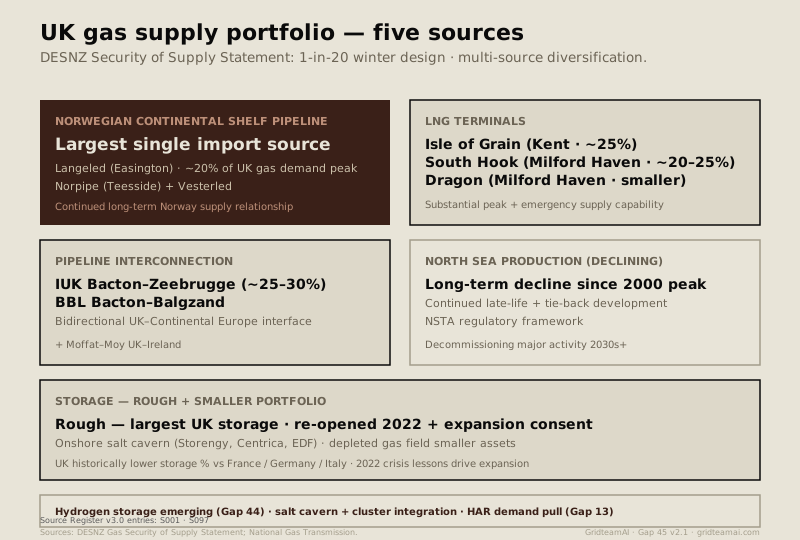
Figure 1 · UK gas supply portfolioFive sources · 1-in-20 design
Five supply sources, diversified by design.
Norwegian Continental Shelf pipeline (the largest single import source, ~20% of peak); three LNG terminals (Grain, South Hook, Dragon); IUK and BBL interconnection (~25–30% of peak); a declining North Sea; and the Rough-led storage estate — with hydrogen storage emerging on the salt-cavern and cluster side.
Fig. 1 / Section 1
Norwegian pipeline (umber) is the largest single source. The UK favours supply diversity over high storage volumes.
Quarterly Sector Report · Gap 452 · Twelve findings · p. 10
09 — 102 · Six findings · 01 – 04 · 2×2 grid
2 · Twelve findings on gas supply security10
2 · Twelve findings on gas supply securityQ1 2032
Twelve findings. Each carries a confidence level.
HIGH — anchored to a verified DESNZ position. MEDIUM — named industry coverage with credible methodology. LOW — GridteamAI projection where the source supports direction but not magnitude.
Findings 01 – 12 · summary
01UK gas supply rests on five diversified sources, not on high storage volumes.
02Rough re-opened in 2022 and doubled to ~54 bcf — roughly half of all UK storage.
03UK storage remains structurally low relative to France, Germany and Italy.
04Three LNG terminals give substantial peak and emergency import capability.
05Norwegian pipeline gas is the UK’s largest single import source.
06IUK and BBL interconnection integrates the UK with continental European gas markets.
07North Sea production is in long-term decline, raising import dependence.
08Hydrogen storage is the emerging long-term requirement — salt cavern most suitable.
09Rough’s potential £2 bn hydrogen redevelopment could be Europe’s largest H2 store.
10The DESNZ 1-in-20 winter design is the operative security-of-supply standard.
11Cold-winter, low-wind concurrence is the binding cross-utility resilience test.
12Implications for storage operators, LNG terminals, NGT, DESNZ and Ofgem.
Findings 01 – 09 follow in detail · pp. 10 – 12 · 10 – 12 summarised on the matrix
Quarterly Sector Report · Gap 452
112 · Findings 01 – 03
2 · Findings 01 — 03The portfolio · Rough · the storage gap
Finding 01 · HIGH
UK gas supply rests on five diversified sources, not on high storage volumes.
UK gas supply security is a portfolio of five sources, deliberately diversified rather than storage-heavy. Norwegian Continental Shelf pipeline gas (Langeled, Norpipe, Vesterled) is the largest single import source at ~20% of peak. LNG terminals (Isle of Grain, South Hook, Dragon) provide substantial peak and emergency import. IUK and BBL interconnection (~25–30% of peak) integrates the UK with continental Europe. North Sea production, though declining, still contributes. And the storage estate — Rough plus salt caverns — provides seasonal and short-cycle flexibility. The UK has historically chosen this supply diversity over the high seasonal storage volumes held by France, Germany and Italy.
Finding 02 · HIGH
Rough re-opened in 2022 and doubled to ~54 bcf — roughly half of all UK storage.
Rough, off the East Yorkshire coast at Easington, is the largest UK gas store — a depleted offshore gas field operated by Centrica Storage. Centrica partially closed it in 2017 on ageing-infrastructure and economic grounds, removing a large share of UK storage volume. In June/July 2022, as a strategic response to the European gas crisis, Centrica applied to the NSTA and re-opened Rough at ~30 bcf (about 20% of its previous capacity but adding ~50% to UK storage volume in one move). It then doubled to ~54 bcf in summer 2023, providing roughly half of all current UK gas storage. Annual NSTA consent extensions have continued, the most recent in 2025.
Finding 03 · HIGH
UK storage remains structurally low relative to France, Germany and Italy.
Even after the Rough re-opening, UK gas storage capacity, measured as a percentage of annual demand, remains substantially lower than France, Germany and Italy. Continental European countries built higher storage because of greater pipeline-import dependency; the UK instead relied on supply diversification — LNG, interconnection, North Sea and Norway. The 2022 crisis exposed the trade-off: diversification held, but at high LNG-utilisation and high price exposure. Beyond Rough, the UK holds multiple smaller onshore salt-cavern and depleted-field assets (Storengy at Stublach and Atwick, Centrica, EDF) that provide short-cycle, within-day flexibility rather than seasonal volume. The structural thinness of seasonal storage is the portfolio’s recognised weak point.
 GridteamAI