Repurposing the gas grid for hydrogen — blending, 100% conversion or a hybrid regional approach, and the hydrogen-for-heat decision that chooses between them.
UK Gas Network Repurposing for Hydrogen · Executive summary05
00 · Executive SummaryA two-page brief
Three pathways, evaluated under one strategic decision.
Pathway 1 — hydrogen blending up to ~20% by volume — is technically feasible without major conversion; existing pipework and appliances tolerate it, and the HyDeploy programme (Cadent, NGN, Wales & West) has demonstrated operational and safety viability.
Pathway 2 — 100% hydrogen conversion — requires network material upgrades and hydrogen-ready appliances; the H100 Fife (SGN) and Hydrogen Village (Cadent, NGN) proposals are the pilots. Pathway 3 — a hybrid regional approach — runs 100% hydrogen in clusters and electrification elsewhere.
The hydrogen-for-heat decision selects between them. It turns on hydrogen supply (HAR rounds and CCUS clusters, Gap 13, 33), production cost, the heat-pump and heat-network alternative (Gap 14), customer acceptance and stranded-asset minimisation — and drives RIIO-GT3 and GD3 (Gap 43) investment direction.
The question is whether 100% hydrogen plays a major role in domestic heat — or not.
Blending is the no-regrets step — ~20% by volume cuts CO2 by ~7%, provides an initial hydrogen demand pull, and builds operational and safety experience. 100% conversion is the strategic bet: it requires network upgrades, hydrogen-ready boilers and a customer-conversion programme, and a different safety framework (HSE, IGEM hydrogen-specific standards). The hybrid regional approach is, on current evidence, the most pragmatic long-term scenario.
The Q4 2031 picture
Blending is operational at pilot scale and moving toward a wider commercial framework; the 100%-conversion pilots (H100 Fife, Hydrogen Village) have reported; CCUS clusters are scaling blue-hydrogen supply; and the hydrogen-for-heat decision is taken or imminent — resolving, at last, the investment direction the gas networks have planned around for a decade.
The shape of this volume. Section 1 sets out the headline figures. Section 2 develops twelve findings, each confidence-annotated. A chapter-weight pull at p. 14 anchors the argument. Section 3 sets out the three pathways. Section 4 details the pilot programmes and CCUS-cluster integration. Section 5 covers the hydrogen-for-heat decision, risks and the outlook. Section 6 makes recommendations, with a one-page tear-out at p. 25.
Executive summary · ends1 · The headline figures · p. 07
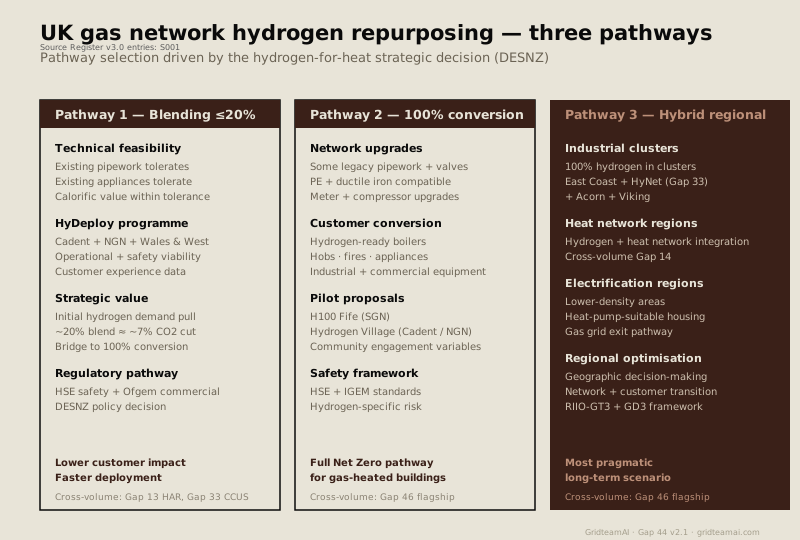
09 · FIG. 11 · The three hydrogen pathways · restyled -v2
1 · The headline figures09
Figure 1 · The three hydrogen pathwaysBlending · 100% · hybrid
Three repurposing pathways, one strategic decision.
Pathway 1, blending up to 20% (HyDeploy, feasible without major conversion); Pathway 2, 100% conversion (network upgrades, hydrogen-ready appliances, H100 Fife and Hydrogen Village pilots); Pathway 3, hybrid regional (100% hydrogen in clusters, electrification elsewhere) — the hydrogen-for-heat decision selects between them.
Fig. 1 / Section 1
Pathway 3 (umber) — hybrid regional — is the most pragmatic long-term scenario. The networks can deliver any of the three.
Quarterly Sector Report · Gap 442 · Twelve findings · p. 10
09 — 102 · Six findings · 01 – 04 · 2×2 grid
2 · Twelve findings on hydrogen repurposing10
2 · Twelve findings on hydrogen repurposingQ4 2031
Twelve findings. Each carries a confidence level.
HIGH — anchored to a verified DESNZ position. MEDIUM — named industry coverage with credible methodology. LOW — GridteamAI projection where the source supports direction but not magnitude.
Findings 01 – 12 · summary
01Three pathways are being evaluated: blending, 100% conversion, hybrid regional.
02Hydrogen blending up to ~20% by volume is technically feasible without major conversion.
03The HyDeploy programme has demonstrated blending operational and safety viability.
04100% conversion requires network upgrades and hydrogen-ready appliances.
05H100 Fife and Hydrogen Village are the 100%-conversion pilot proposals.
06Hydrogen safety differs materially from natural gas and needs new standards.
07The hybrid regional approach is the most pragmatic long-term scenario.
08CCUS clusters integrate blue-hydrogen supply into the gas network.
09HAR rounds drive UK hydrogen production scale for blending and conversion.
10The hydrogen-for-heat decision is the single largest variable.
11Stranded-asset risk depends on which pathway is chosen.
12Implications for the networks, manufacturers, clusters and customers.
Findings 01 – 09 follow in detail · pp. 10 – 12 · 10 – 12 summarised on the matrix
Quarterly Sector Report · Gap 442
112 · Findings 01 – 03
2 · Findings 01 — 03The networks · the RIIO framework · the demerger
Finding 01 · HIGH
Three pathways are being evaluated: blending, 100% conversion, hybrid regional.
Repurposing the gas networks for hydrogen is being evaluated along three pathways. Hydrogen blending adds hydrogen (typically up to ~20% by volume) into the existing natural-gas network without major conversion — technically feasible and demonstrated. 100% hydrogen conversion fully converts the network, appliances and commercial gas use to hydrogen, requiring substantial network upgrades and a customer-conversion programme. The hybrid regional approach runs 100% hydrogen in industrial and heat-network clusters while lower-density regions take gas-grid exit and electrification. The three are not mutually exclusive: blending is a near-term step that can bridge to conversion or persist as an equilibrium, and the hybrid approach combines conversion and exit by geography.
Finding 02 · HIGH
Hydrogen blending up to ~20% by volume is technically feasible without major conversion.
Hydrogen blending up to ~20% by volume has been demonstrated as technically feasible in existing UK gas networks: existing pipework tolerates the blend, valves and fittings tolerate it, and customer appliances — boilers, hobs, fires — tolerate it without modification, with the wholesale-gas calorific value and Wobbe Index staying within tolerance bands. Blending therefore offers a near-term decarbonisation step that requires no customer disruption and no appliance replacement. Its limits are equally clear: at ~20% by volume the CO2 saving is only ~7% (hydrogen is far less energy-dense than methane), so blending alone cannot decarbonise heat — it is a bridge and a demand-pull, not a destination.
Finding 03 · HIGH
The HyDeploy programme has demonstrated blending operational and safety viability.
HyDeploy is the principal UK hydrogen-blending trial programme — Cadent, Northern Gas Networks, Wales & West Utilities and others — running multiple trial sites at up to 20% hydrogen by volume and gathering operational, safety and customer-experience data. Its outputs inform the regulatory and commercial decisions that a wider blending rollout requires: HSE safety assessment and approval, an Ofgem regulatory and commercial framework, a DESNZ policy decision on blending level and timing, and Energy Networks Association coordination. HyDeploy is the evidence base that makes blending the no-regrets near-term step — it has answered the technical and safety questions, leaving the commercial and policy ones.
 GridteamAI