UK Gas Networks — RIIO-GT3 + GD3 · Executive summary05
00 · Executive SummaryA two-page brief
A regulated monopoly funded across a shrinking demand base.
UK gas networks are National Gas Transmission (NGT, ~7,660 km, demerged from National Grid in 2023) plus four GDNs — Cadent (~11M customers), SGN (~5.9M), NGN (~2.7M) and Wales & West Utilities (~2.5M) — serving ~24M customers over ~280,000 km.
Ofgem regulates them under RIIO. RIIO-GT3 and GD3 run 2026–2031; Ofgem published the Sector Specific Methodology Decision in July 2024, and on 4 December 2025 the RIIO-3 Final Determinations approved £28.7 bn of upfront funding in 2023/24 prices (18% more than the draft decisions) within a RIIO-3 pipeline of about £90 bn.
This is the first gas price control during structural demand decline — heat decarbonisation, falling power-sector gas and industrial substitution all cut throughput. The networks must fund safe operation and the Repex programme across a shrinking base, prepare for hydrogen (Gap 44) and manage stranded-asset and affordability risk.
The question is how to fund a safe, reliable network as throughput and the customer base shrink.
RIIO-GT3 and GD3 set a Totex revenue allowance with cost-of-debt and cost-of-equity components, performance commitments and Outcome Delivery Incentives, and an innovation framework. The capex envelope is materially smaller than RIIO-T2 and GD2 given the decarbonisation trajectory — with asset replacement (Repex), safety, resilience and hydrogen-readiness the priorities. Stranded-asset risk and bill affordability are the binding constraints.
The Q3 2031 picture
RIIO-GT3 and GD3 in force five years and approaching the next control period; gas demand materially lower; the Repex programme near completion; hydrogen blending piloted but the 100%-conversion question unresolved pending the hydrogen-for-heat decision; per-customer network charges rising as costs spread across fewer customers.
The shape of this volume. Section 1 sets out the headline figures. Section 2 develops twelve findings, each confidence-annotated. A chapter-weight pull at p. 14 anchors the argument. Section 3 sets out the network structure — NGT and the four GDNs. Section 4 details the RIIO-GT3 and GD3 framework. Section 5 covers the gas-grid transition, risks and the outlook. Section 6 makes recommendations, with a one-page tear-out at p. 25.
Executive summary · ends1 · The headline figures · p. 07
09 · FIG. 11 · The UK gas network structure · restyled -v2
1 · The headline figures09
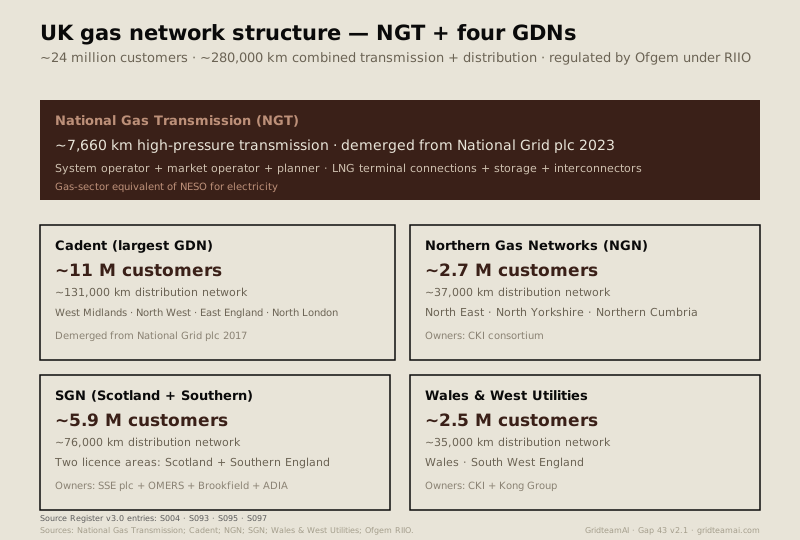
Figure 1 · The UK gas network structureNGT · 4 GDNs · Ofgem RIIO
One transmission operator over four distribution networks.
National Gas Transmission (~7,660 km, demerged 2023) sits above Cadent (~11M customers), SGN (~5.9M), Northern Gas Networks (~2.7M) and Wales & West Utilities (~2.5M) — ~24M customers over ~280,000 km, all regulated by Ofgem under RIIO.
Fig. 1 / Section 1
NGT (umber) is the transmission spine; the four GDNs distribute to ~24M customers. All five are RIIO-regulated monopolies.
Quarterly Sector Report · Gap 432 · Twelve findings · p. 10
09 — 102 · Six findings · 01 – 04 · 2×2 grid
2 · Twelve findings on the gas networks10
2 · Twelve findings on the gas networksQ3 2031
Twelve findings. Each carries a confidence level.
HIGH — anchored to a verified DESNZ position. MEDIUM — named industry coverage with credible methodology. LOW — GridteamAI projection where the source supports direction but not magnitude.
Findings 01 – 12 · summary
01UK gas networks are NGT plus four GDNs serving ~24 million customers.
02National Gas Transmission is the gas-sector equivalent of NESO.
03Ofgem regulates the networks under the RIIO framework.
04RIIO-GT3 and GD3 cover the 2026–2031 control period.
05The RIIO-3 Final Determinations approved £28.7 bn of upfront funding in 2023/24 prices.
06This is the first gas price control during structural demand decline.
08The Repex cast-iron-mains programme continues independent of demand.
09Hydrogen blending up to 20% is feasible without major conversion.
10The hydrogen-for-heat decision is the most consequential variable.
11Stranded-asset risk and bill affordability are the binding constraints.
12The Q3 2031 picture: lower demand, the conversion question unresolved.
Findings 01 – 09 follow in detail · pp. 10 – 12 · 10 – 12 summarised on the matrix
Quarterly Sector Report · Gap 432
112 · Findings 01 – 03
2 · Findings 01 — 03The networks · the RIIO framework · the demerger
Finding 01 · HIGH
UK gas networks are NGT plus four GDNs serving ~24 million customers.
UK gas networks comprise National Gas Transmission (NGT) — the high-pressure transmission system, ~7,660 km, demerged from National Grid plc in 2023 — and four Gas Distribution Networks: Cadent (the largest, ~11M customers, ~131,000 km), SGN (~5.9M, ~76,000 km, Scotland and Southern England), Northern Gas Networks (~2.7M) and Wales & West Utilities (~2.5M). Together they serve roughly 24 million customers, predominantly domestic heating, over some 280,000 km of combined transmission and distribution pipe. All five are regulated monopoly network operators under RIIO, with geographically defined service areas and connection, capacity, safety and reliability obligations.
Finding 02 · HIGH
National Gas Transmission is the gas-sector equivalent of NESO.
NGT is the UK gas transmission system operator — the gas-sector equivalent of NESO for electricity, combining system operator, market operator and planner roles. It transports gas from terminals (LNG at Isle of Grain, South Hook and Dragon; the Norwegian pipeline) and storage (Rough) to GDN entry points, large industrial users and power generation; runs the wholesale gas market and real-time system balancing; allocates capacity to shippers and suppliers; and manages interconnections with the EU (Interconnector UK, BBL) and Ireland. Demerged from National Grid plc in 2023, it sits at the centre of UK gas supply security — and its RIIO-GT3 settlement funds the transmission resilience the whole system depends on.
Finding 03 · HIGH
Ofgem regulates the networks under the RIIO framework.
Gas networks are regulated by Ofgem under RIIO — Revenue = Incentives + Innovation + Outputs — the framework also used for electricity transmission and distribution. RIIO sets a Totex revenue allowance (combined capex and opex) with cost-of-debt and cost-of-equity components, an outputs framework with performance commitments and Outcome Delivery Incentives, and an innovation framework (the Network Innovation Allowance and Strategic Innovation Fund). RIIO has run in iterations: RIIO-1 (2013–2021), RIIO-2 (gas 2021–2026) and now RIIO-3. The framework is designed to balance investor returns, customer bills and network performance — a balance that the structural gas-demand decline makes materially harder to strike.
 GridteamAI