Outside the
Framework.
The two devolved water sectors that sit outside PR24 and WRMP24 — Scottish Water and NI Water, their separate regulators, ownership models and the Lanarkshire AIGZ pressure.
This is part of the paid GridteamAI Quarterly Sector Report.
£295 single volume · £995/yr annual · Team £2,495 · Enterprise £4,995 · Corporate £9,995. Secure checkout coming soon; email to purchase today.
The two devolved water sectors that sit outside PR24 and WRMP24 — Scottish Water and NI Water, their separate regulators, ownership models and the Lanarkshire AIGZ pressure.
Scottish Water is a public corporation owned by the Scottish Government, regulated by WICS (economic), SEPA (environmental) and the DWQR — on a six-year Strategic Review of Charges cycle (SRC21, SRC27 in development), longer than Ofwat’s five.
NI Water is a government-owned company reporting to the Department for Infrastructure, regulated by the Utility Regulator (a multi-utility economic regulator), NIEA and DWI NI on a PC cycle. Domestic charges have been suspended since 2007; a government grant covers domestic supply — a materially different funding model.
Both have material supply-demand headroom — high rainfall, lower population density, substantial reservoir storage — and lower drought sensitivity than English regions. The Lanarkshire AIGZ (Gap 18) concentrates Scotland-specific industrial demand; NI has no AIGZ as of WRMP24. Devolved policy may diverge — Scotland targets Net Zero by 2045, five years ahead of the UK.
GridteamAI base case: Scottish Water delivers SRC21 and develops SRC27, with Lanarkshire AIGZ demand the key new pressure; NI Water delivers PC21 and develops PC27 within its grant-funded model; devolved policy diverges gradually from England and Wales; and cross-UK coordination stays informational, with NI political stability the key continuity risk.
The shape of this volume. Section 1 sets out the headline figures. Section 2 develops twelve findings, each confidence-annotated. A chapter-weight pull at p. 14 anchors the argument. Section 3 covers Scottish Water — ownership, regulation and supply-demand. Section 4 covers NI Water. Section 5 covers cross-UK coordination, divergence risks and the outlook. Section 6 makes recommendations, with a one-page tear-out at p. 25.
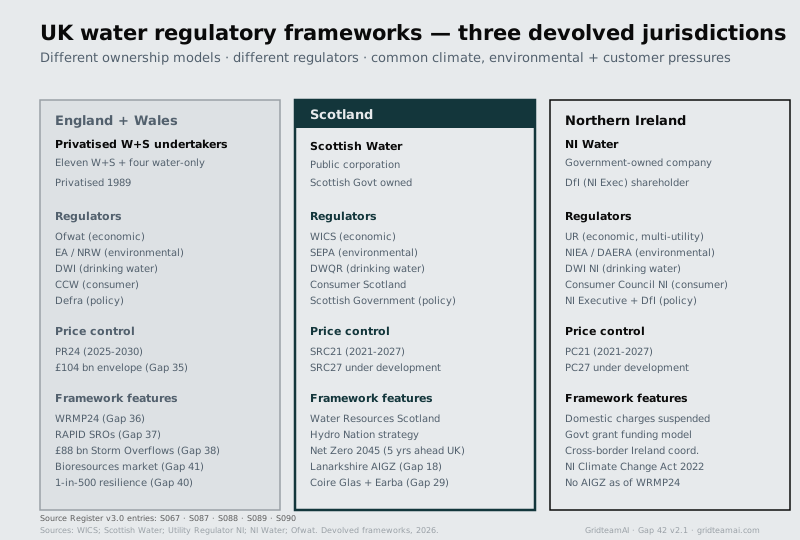
England and Wales (privatised undertakers under Ofwat, PR24, the £104 bn envelope), Scotland (the public corporation Scottish Water under WICS, SEPA and the SRC cycle), and Northern Ireland (the government-owned NI Water under the Utility Regulator, NIEA and the PC cycle) — different ownership, different regulators, common pressures.
Scotland (teal) is the focal jurisdiction; NI is ink-outlined. Three frameworks, one shared climate.
HIGH — verified against WICS, the Utility Regulator NI, SEPA/NIEA, Scottish Water or NI Water reporting. MEDIUM — named Scottish Government or NI Executive policy cross-referenced to a primary source. LOW — GridteamAI scenario projection, marked as such.
Findings 01 – 12 · summary
Findings 01 – 09 follow in detail · pp. 10 – 12 · 10 – 12 summarised on the matrix
The eight-volume Water beachhead covers, in Gaps 35–41, the eleven English and Welsh water-and-sewerage undertakers and four water-only companies under Ofwat, Defra, the EA and the DWI. Scotland and Northern Ireland operate entirely separate regulatory and commercial frameworks. PR24, WRMP24, the RAPID SRO process, the £88 bn Storm Overflows programme and the Bioresources market are all England-and-Wales instruments; none applies in Scotland or NI. Both devolved sectors face the same climate, environmental and customer pressures, but under different ownership, regulators and funding — which is why a UK-wide water-sector view is incomplete without them.
Scottish Water is a public corporation: the Scottish Government is sole shareholder, the Board is appointed by Scottish Ministers, and policy is set by the relevant Cabinet Secretary. This differs materially from the English and Welsh model, where the undertakers were privatised in 1989 — Scotland retained public ownership. Economic regulation is by the Water Industry Commission for Scotland (WICS) on a six-year Strategic Review of Charges cycle (SRC21, 2021–2027; SRC27 in development), longer than Ofwat’s five; SEPA regulates the environment, the DWQR drinking-water quality, and Consumer Scotland represents customers. WICS methodology draws on Ofwat but is adapted for the Scottish public-ownership context.
NI Water is a government-owned company (GoCo): the Department for Infrastructure is sole shareholder, and the NI Executive Minister for Infrastructure sets policy. This differs from both the English privatised model and the Scottish public-corporation model — NI Water is a discrete company under government ownership. Economic regulation is by the Utility Regulator (UR), a single multi-utility regulator covering electricity, gas and water, on the PC15/PC21/PC27 cycle; NIEA (within DAERA) regulates the environment, DWI NI drinking water, and the Consumer Council NI represents customers. Crucially, domestic water charges have been suspended since 2007, with a government grant covering domestic supply alongside non-domestic and industrial customer revenue.