The 1-in-500
Standard.
Drought response and a climate-adjusted resilience standard — the four-stage plan, the 1-in-500 uplift and the SRO delivery the 2039 deadline depends on.
This is part of the paid GridteamAI Quarterly Sector Report.
£295 single volume · £995/yr annual · Team £2,495 · Enterprise £4,995 · Corporate £9,995. Secure checkout coming soon; email to purchase today.
Drought response and a climate-adjusted resilience standard — the four-stage plan, the 1-in-500 uplift and the SRO delivery the 2039 deadline depends on.
The UK has moved from a 1-in-200 to a 1-in-500 year drought resilience standard (WRMP24, by 2039) — a 2.5× uplift, adopted after the 2018 and 2022 droughts and explicitly accounting for climate-adjusted severity.
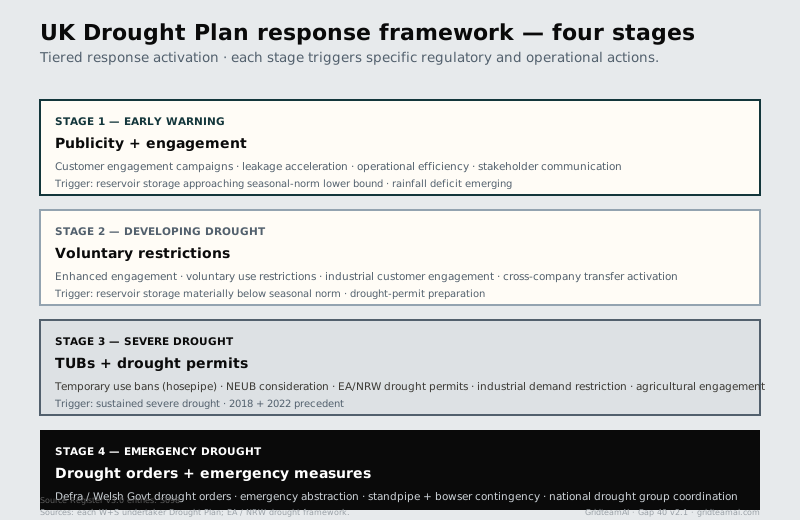
Tactical response runs through each undertaker’s statutory Drought Plan: a four-stage escalation from early warning, to voluntary restrictions, to temporary use bans and drought permits, to drought orders and emergency measures. The 2022 drought was the most extensive response in recent memory and the catalyst for the 1-in-500 standard.
The framework is multi-regulator — Defra (policy and drought orders), the EA and NRW (drought permits), Ofwat (PR24 and conduct), the DWI, CCW and the Met Office (UKCP). Climate change drives drier summers, higher peak demand and higher drought severity; the 1-in-500 standard is the primary driver of SRO investment (Gap 37).
GridteamAI base case: the 1-in-500 trajectory advances on SRO delivery; Drought Plans are refreshed on the five-year cycle; WRMP29 incorporates updated UKCP science; and drought-response capability is tested by climate-projected rising frequency, with multi-regional concurrent drought the key emerging risk.
The shape of this volume. Section 1 sets out the headline figures. Section 2 develops twelve findings, each confidence-annotated. A chapter-weight pull at p. 14 anchors the argument. Section 3 steps through the four-stage drought response. Section 4 covers the multi-regulator coordination stack. Section 5 covers climate adjustment, risks and the outlook. Section 6 makes recommendations, with a one-page tear-out at p. 25.
Each Drought Plan defines tiered triggers: Stage 1 early warning (publicity and engagement), Stage 2 developing drought (voluntary restrictions), Stage 3 severe drought (TUBs and drought permits), Stage 4 emergency drought (drought orders and emergency measures). Each tier triggers specific regulatory and operational actions.
Stage 1 (teal) escalates to emergency (ink). The 2022 drought reached Stage 3–4 across multiple companies.
HIGH — verified against Defra drought policy, the Water Industry Act 1991, the EA/NRW drought framework or UKCP18. MEDIUM — named UK drought-record or industry coverage cross-referenced to a primary source. LOW — GridteamAI scenario projection, marked as such.
Findings 01 – 12 · summary
Findings 01 – 09 follow in detail · pp. 10 – 12 · 10 – 12 summarised on the matrix
UK drought planning combines a strategic resilience framework with a tactical response. Strategically, the 1-in-500 year drought resilience standard by 2039 (WRMP24 and Defra policy) sets the system requirement, with climate-adjusted reliable yields under UKCP18 and the SRO portfolio (Gap 37) providing the supply-side capacity. Tactically, each W+S undertaker maintains a statutory Drought Plan (Water Industry Act 1991, Water Resources Act 1991) covering EA and NRW drought permits and orders, temporary and non-essential use bans, and multi-stakeholder coordination across CCW, the agricultural sector, industrial users, environmental NGOs and local authorities.
The previous 1-in-200 year resilience standard was exposed by the 2018 and 2022 droughts as insufficient. Defra adopted the 1-in-500 year standard in WRMP24, requiring each company’s system to meet customer demand through a drought severe enough to have a 1-in-500 chance of occurring in any year, under climate-adjusted projections — a roughly 2.5× uplift. The standard explicitly accounts for climate-adjusted drought severity, and is the primary driver of the £20–30 bn SRO investment programme (Gap 37). Meeting it by 2039 depends on SRO delivery; a delivery shortfall is a drought-resilience gap.
Drought planning is statutory under the Water Industry Act 1991 (Section 39B, the duty to maintain a Drought Plan), the Water Resources Act 1991 (EA drought-permit powers), the Drought Act 1976 (Secretary of State drought orders), the Flood and Water Management Act 2010 (TUB powers) and the Environment Act 2021 (environmental-flow protection). Each W+S undertaker publishes a Drought Plan, reviewed every five years in parallel with the WRMP, covering triggers, response actions, customer engagement and post-drought recovery — subject to public consultation and Secretary of State (or Welsh Government) approval, and coordinated with the EA, NRW, the DWI and Defra.