The Cooling
Constraint.
AI compute, cooling water and the AIGZ map — where data-centre demand lands inside the WRMP24 framework, and what the catchments will bear.
This is part of the paid GridteamAI Quarterly Sector Report.
£295 single volume · £995/yr annual · Team £2,495 · Enterprise £4,995 · Corporate £9,995. Secure checkout coming soon; email to purchase today.
AI compute, cooling water and the AIGZ map — where data-centre demand lands inside the WRMP24 framework, and what the catchments will bear.
UK industrial water demand is approximately 15–20% of public water supply plus direct abstraction — and within it, data-centre cooling is the single fastest-growing segment, concentrated in the five AI Growth Zones and the historical Thames Valley cluster.
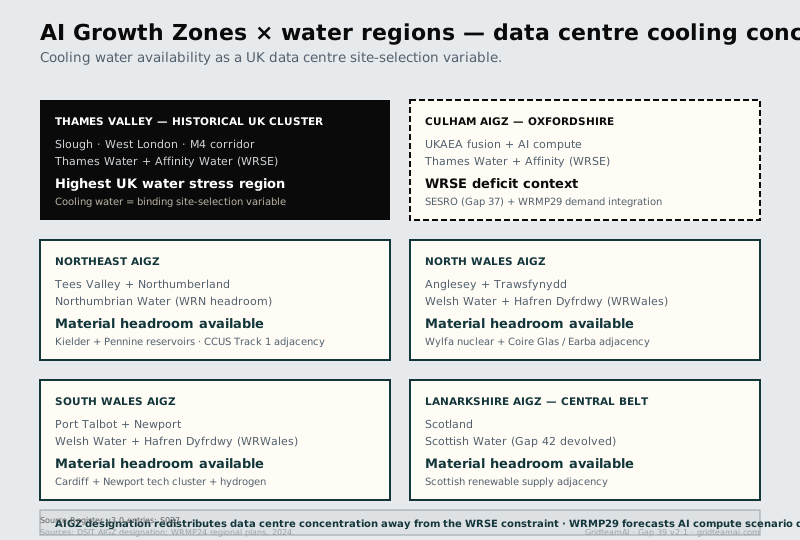
The Thames Valley — Slough, West London, the M4 corridor — is the primary UK cluster and the highest water-stress region (the WRSE deficit), where cooling water is now a binding site-selection variable. The four headroom AIGZs — Northeast, North Wales, South Wales, Lanarkshire — were designated with water availability explicitly in view.
The cooling-technology trajectory runs from evaporative (high water, low energy) toward hybrid, dry and immersion / liquid cooling — the last increasingly required by AI GPU density. AI-compute growth is the single largest uncertainty in WRMP29 demand forecasting (draft 2028, final 2029).
GridteamAI base case: WRMP29 industrial demand forecasting uses AI-compute low/medium/high scenarios; AIGZ designation redistributes some demand to headroom regions; Thames Valley new-build shifts to hybrid, dry and immersion cooling; non-potable supply development grows in constrained catchments.
The shape of this volume. Section 1 sets out the headline figures. Section 2 develops twelve findings, each confidence-annotated. A chapter-weight pull at p. 14 anchors the argument. Section 3 steps through the cooling load and the AIGZ map. Section 4 covers WRMP forecasting and demand. Section 5 covers cooling technology, risks and the outlook. Section 6 makes recommendations, with a one-page tear-out at p. 25.
The Thames Valley historical cluster sits in the WRSE deficit region, where cooling water is a binding site-selection variable. The four headroom AIGZs — Northeast, North Wales, South Wales, Lanarkshire — were designated with water availability in view; Culham sits in the WRSE context.
Thames Valley (ink) is the binding constraint; four headroom AIGZs (teal) have material capacity. Designation follows water as well as grid.
HIGH — verified against WRMP24, DSIT AIGZ designation, Defra non-household policy or the Tranche 1 Gap 19/23 baseline. MEDIUM — named UK industry coverage (techUK, Data Centre Alliance) cross-referenced to a primary source. LOW — GridteamAI scenario projection, marked as such.
Findings 01 – 12 · summary
Findings 01 – 09 follow in detail · pp. 10 – 12 · 10 – 12 summarised on the matrix
UK industrial water demand is a heterogeneous category — power generation, manufacturing, chemicals, food and beverage, paper and pulp, refining and petrochemicals, semiconductors, pharmaceuticals and life sciences, and the rapidly-growing data-centre cooling load. In aggregate it is approximately 15–20% of UK public water supply consumption plus direct abstraction. Demand is concentrated in cluster locations (Teesside, Humber, Merseyside, Grangemouth, the Cambridge corridor, the Wales semiconductor cluster), major urban regions, the Thames Valley data-centre cluster, and port, LNG and hydrogen sites. The fastest-growing segments through 2030–2040 are data-centre cooling, semiconductors and life sciences, hydrogen production and CCUS.
Within industrial demand, data-centre cooling is the single fastest-growing segment, AIGZ-concentrated and dominated by the Thames Valley, Greater Manchester, North and South Wales and Central Belt Scotland. Cooling load tracks IT load: as AI-compute density rises, cooling demand rises with it. The historical UK installed base is predominantly evaporative cooling, the most water-intensive technology, concentrated in the Thames Valley — the highest water-stress UK region. This is why cooling water has moved from a secondary site-selection consideration to, in the WRSE region, a binding constraint on where new compute can land.
Industrial demand splits between public water supply (PWS — supplied via undertaker networks, billed at non-household tariff, forecast in the WRMP non-household category) and direct abstraction (abstracted under EA or NRW licence, regulated independently of WRMP forecasting). Power generation, chemicals, refining and some large manufacturing typically use direct abstraction; data centres, semiconductors, pharmaceuticals, life sciences and food and beverage typically use PWS. England’s non-household water market opened for retail competition in 2017 (Wales separate); customers choose a retailer while wholesale supply stays with the W+S undertakers. The split matters because abstraction reform (Gap 36) tightens one channel while WRMP forecasting governs the other.