The £88bn
Clean-Up.
Storage, treatment and source control — the £88 bn programme to cut sewage discharges across England and Wales to 2050.
This is part of the paid GridteamAI Quarterly Sector Report.
£295 single volume · £995/yr annual · Team £2,495 · Enterprise £4,995 · Corporate £9,995. Secure checkout coming soon; email to purchase today.
Storage, treatment and source control — the £88 bn programme to cut sewage discharges across England and Wales to 2050.
The £88 billion storm-overflow programme is the largest UK water-industry capital commitment of the modern era — storage, treatment capacity, separation and SuDS delivered across PR24, PR29, PR34 and PR39 to 2050.
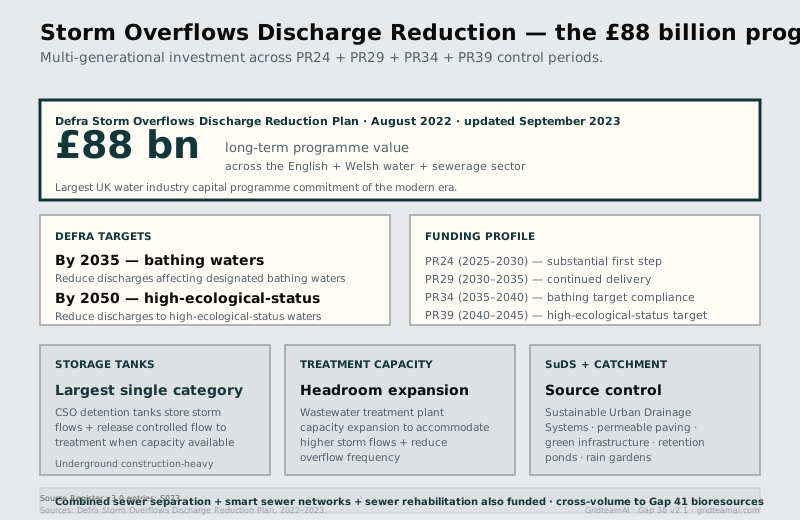
Defra’s Storm Overflows Discharge Reduction Plan (August 2022, updated 2023) sets the statutory targets under the Environment Act 2021: reduce discharges affecting designated bathing waters by 2035 and discharges to high-ecological-status waters by 2050, with a sector-wide annual-average reduction. PR24 funds the first material step.
The enforcement framework — Defra policy, EA and NRW monitoring, Ofwat regulation, the DWI, and the Water (Special Measures) Act 2025, with automatic fines planned once the regulations are approved and prison for anyone who obstructs an investigation — sits over near-universal Event Duration Monitoring. Public and political pressure is structural through the delivery horizon.
GridteamAI base case: PR24 storm-overflow programmes in early delivery across the eleven W+S undertakers; EDM coverage substantially complete with annual EA publication; the Water (Special Measures) Act driving enforcement and risk-averse delivery; Thames Water restructuring the principal execution risk for the largest single programme.
The shape of this volume. Section 1 sets out the headline figures. Section 2 develops twelve findings, each confidence-annotated. A chapter-weight pull at p. 14 anchors the argument. Section 3 steps through the programme and the engineering response. Section 4 covers monitoring and enforcement. Section 5 covers supply chain, risks and the outlook. Section 6 makes recommendations, with a one-page tear-out at p. 25.
Defra’s Storm Overflows Discharge Reduction Plan: a sector-wide £88 bn envelope funded across PR24/PR29/PR34/PR39, with targets for bathing waters by 2035 and high-ecological-status waters by 2050. The engineering response is weighted to storage tanks, treatment-capacity expansion and SuDS source control.
Storage tanks (teal) are the largest single spend category. £88 bn, four control periods, to 2050.
HIGH — verified against Defra, the Environment Act 2021, the Water (Special Measures) Act 2025, Ofwat or EA EDM data. MEDIUM — named UK industry coverage cross-referenced to a primary source. LOW — GridteamAI scenario projection, marked as such.
Findings 01 – 12 · summary
Findings 01 – 09 follow in detail · pp. 10 – 12 · 10 – 12 summarised on the matrix
The storm overflow + CSO reduction programme is the most significant UK water infrastructure capital commitment of the modern era — a sector-wide £88 bn envelope across the English and Welsh water and sewerage sector, delivered across PR24, PR29, PR34 and PR39 to 2050. The figure incorporates Defra’s £56 bn 25-year core programme plus parallel investment in combined-sewer separation, treatment-plant headroom, SuDS source control, monitoring and sewer rehabilitation that sits across multiple price-control cycles. PR24 funds the most material first step. The two figures are not in conflict; they reflect different scope boundaries, and the canonical figure should be independently verified at publication window.
Storm overflows are part of the combined-sewer infrastructure inherited from Victorian-era sewer construction. Combined sewers carry both foul wastewater and surface-water runoff; during heavy rainfall they exceed treatment-plant capacity and discharge via storm overflows to prevent sewer flooding of homes and streets. The fundamental engineering challenge is reducing combined-sewer overflow events through infrastructure intervention — separation of foul and surface flows, increased treatment capacity, storage capacity for storm events, and source control of surface water (SuDS). This is a multi-generational asset-renewal problem, not a single-cycle fix.
Defra published the Storm Overflows Discharge Reduction Plan in August 2022, updated September 2023 — the statutory framework under the Environment Act 2021 (Sections 81–83 set the duty on undertakers to "secure a progressive reduction in the adverse impacts of discharges from the undertaker’s storm overflows"). The quantified targets: reduce discharges affecting designated bathing waters by 2035; reduce discharges to high-ecological-status waters by 2050; and a sector-wide annual-average reduction. Each undertaker publishes Drainage + Wastewater Management Plans (DWMPs) — the wastewater-side counterpart to the WRMP — setting out the long-term combined-sewer and storm-overflow infrastructure plan.