← GridteamAI

Purchase access

This is part of the paid GridteamAI Quarterly Sector Report.

Purchase access — book@gridteamai.com

£295 single volume · £995/yr annual · Team £2,495 · Enterprise £4,995 · Corporate £9,995. Secure checkout coming soon; email to purchase today.

GridteamAI · Quarterly Sector Report · Gap 34
UK Geothermal & Emerging Clean Tech — United Downs, mine water heat and the emerging-technology survey · Renewables beachhead close
Series consistency · canonical Gap-series system
A4 · 210 × 297 mm · 3 mm bleed (not shown)
UK English · ~30 pp · v2.1 / Q2 2029
FRONT MATTERi · Cover · ink · full bleed
GridteamAI
Quarterly Sector Report
Volume Gap 34
Renewables · Beachhead Close
by GridteamAI
UK · Geothermal · Mine Water Heat · Emerging Tech United Kingdom · Q2 2029

Deep
Heat.

United Downs and mine water heat at commercial deployment — and the emerging clean technologies that close the Renewables beachhead.

gridteamai.com · book@gridteamai.com v2.1 · Q2 2029 Volume 7 · close
05 — 06Executive summary · spread
UK Geothermal & Emerging Clean Tech · Executive summary05
00 · Executive Summary A two-page brief

Deep geothermal proven; mine water heat at commercial deployment.

United Downs (Geothermal Engineering Ltd, Cornwall) is the UK’s first deep geothermal power project — drilling 2–5 km into the Cornish granite to generate both electricity and heat.

UK mine water heat — flooded former coal mines at 13–15°C year-round — is at commercial deployment in Gateshead, Glasgow and Stoke-on-Trent, with heat pumps boosting to district-heating temperature. The Mining Remediation Authority (was the Coal Authority) licenses access.

Mine water heat and deep geothermal are recognised low-carbon supply technologies under the Heat Networks programme — the GHNF (£195m/yr) and Warm Homes Plan (Gap 14). The sector is sub-scale against wind and solar but material for heat decarbonisation and former-mining regeneration.

The Q2 2029 picture

GridteamAI base case: United Downs operational; mine water heat at 5–10 commercial sites; emerging clean technologies in continued R&D and early commercial deployment. The 7th Carbon Budget recognises the diverse-technology contribution.

The shape of this volume. Section 1 sets out the headline figures. Section 2 develops twelve findings, each confidence-annotated. A chapter-weight pull at p. 14 anchors the argument. Section 3 sets out geothermal and mine water heat. Section 4 surveys the emerging clean technologies. Section 5 closes the Renewables beachhead and gives the outlook. Section 6 makes recommendations, with a one-page tear-out at p. 25.

Executive summary · ends1 · The headline figures · p. 07
09 · FIG. 11 · United Downs + mine water heat · restyled -v2
1 · The headline figures09
Figure 1 · Deep geothermal + mine water heatGeothermal Eng. Ltd · operators

United Downs deep geothermal; mine water heat at three sites.

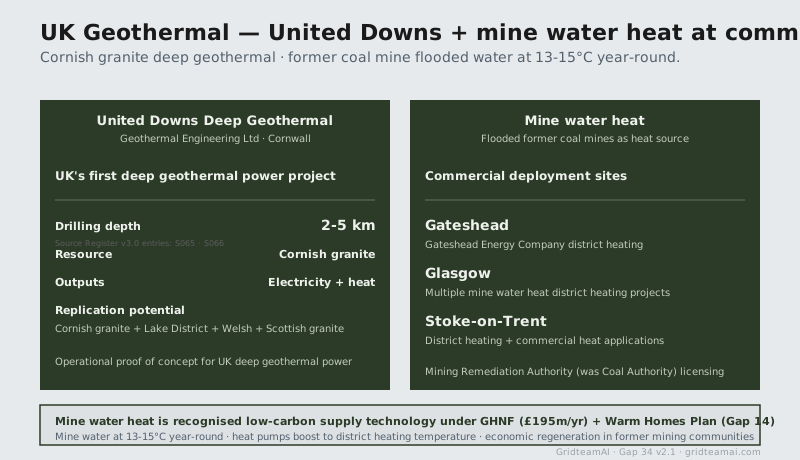
United Downs (Cornwall) is the UK’s first deep geothermal power project — 2–5 km into the Cornish granite, generating electricity and heat. Mine water heat draws on flooded former coal mines at 13–15°C year-round at Gateshead, Glasgow and Stoke-on-Trent.

A two-column composition in moss. Left: United Downs Deep Geothermal Power (Geothermal Engineering Ltd, Cornwall) — the UK’s first deep geothermal power project, drilling 2–5 km into the Cornish granite, producing electricity and heat, with replication potential at Cornish, Lake District, Welsh and Scottish granite. Right: mine water heat at commercial deployment — Gateshead (Gateshead Energy Company district heating), Glasgow (multiple projects) and Stoke-on-Trent — drawing flooded former coal mine water at 13–15°C year-round, licensed by the Mining Remediation Authority. A footer notes mine water heat is a recognised low-carbon supply technology under the GHNF (£195m/yr) and Warm Homes Plan (Gap 14), with heat pumps boosting to district-heating temperature and economic regeneration in former mining communities.
Fig. 1 / Section 1

Deep geothermal (left) and mine water heat (right), both moss. Recognised low-carbon supply under the Heat Networks framework.

Quarterly Sector Report · Gap 342 · Twelve findings · p. 10
09 — 102 · Twelve findings · 01 – 03
2 · Twelve findings on geothermal + emerging tech10
2 · Twelve findings on geothermal + emerging techQ2 2029

Twelve findings. Each carries a confidence level.

HIGH — verified against a named UK developer, the BGS, the Mining Remediation Authority, DESNZ or a recognised industry body. MEDIUM — named UK industry coverage cross-referenced to a primary source. LOW — GridteamAI scenario projection, marked as such.

Findings 01 – 12 · summary

  1. 01United Downs is the UK’s first deep geothermal power project.
  2. 02Mine water heat is at commercial deployment in former mining communities.
  3. 03The British Geological Survey maintains the UK Geothermal data resource.
  4. 04The Mining Remediation Authority licenses mine water access.
  5. 05UK geothermal sits at early commercial deployment.
  6. 06Heat-network integration operationalises geothermal at scale.
  7. 07Geological hydrogen is an emerging UK clean technology.
  8. 08Advanced biofuels, novel storage and OTEC complete the survey.
  9. 09Public finance combines R&D, Heat Networks funding and NWF/GBE.
  10. 10The Q2 2029 outlook depends on the scale-up pathway.
  11. 11The Renewables beachhead concludes with a diverse-technology mix.
  12. 12Implications for developers, the BGS, operators and Government.

Findings 01 – 09 follow in detail · pp. 10 – 12 · 10 – 12 summarised on the matrix

Quarterly Sector Report · Gap 342
112 · Findings 01 – 03
2 · Findings 01 — 03United Downs · mine water · the BGS
Finding 01 · HIGH

United Downs is the UK’s first deep geothermal power project.

The United Downs Deep Geothermal Power project — Geothermal Engineering Ltd, in Cornwall — is the UK’s first deep geothermal power project. It drills deep wells (2–5 km) to access geothermal resource in the Cornish granite, a formation with a naturally elevated heat content driven by radioactive decay in the granite. The project generates both electricity (turbo-generators driven by geothermal heat) and direct heat for district-heating and commercial applications; the combined heat-and-power configuration improves the overall energy economics. For the UK geothermal sector, United Downs is the operational proof of concept for deep geothermal power, and replication at other Cornish granite sites — and at Lake District, Welsh and Scottish granite — provides the scale-up pathway.

Finding 02 · HIGH

Mine water heat is at commercial deployment in former mining communities.

UK mine water heat — using flooded former coal-mine water as a heat source for district-heating networks — is at commercial deployment in former mining communities. Anchor projects include the Gateshead Energy Company district-heating scheme, multiple projects in Glasgow, and district heating in Stoke-on-Trent. Flooded former coal mines provide water at roughly 13–15°C year-round; heat pumps extract that heat and boost it to district-heating supply temperatures. The Mining Remediation Authority (formerly the Coal Authority) provides access licensing and technical data. For former mining communities — many facing both economic and heat-decarbonisation challenges — mine water heat is decarbonisation infrastructure and economic regeneration at once, connecting under the GHNF and Warm Homes Plan framework (Gap 14).

Finding 03 · HIGH

The British Geological Survey maintains the UK Geothermal data resource.

The British Geological Survey (BGS) maintains the UK Geothermal data resource — surveying the UK subsurface for suitable geothermal commercial-development sites. BGS data covers geological resource mapping, temperature gradient, water resource, fracture geometry and commercial-development potential by region. For developers, BGS data is the upstream commercial step: site selection, geological and commercial assessment, and environmental and planning context. The resource is maintained under the Open Government Licence — accessible to commercial developers, academics and policy users. The BGS interaction with the Critical Minerals Strategy (Gap 25) is also relevant: deep geothermal drilling and extraction infrastructure shares technology and supply chain with critical-minerals extraction.

2 · 01 – 03Findings 04 – 06 · facing