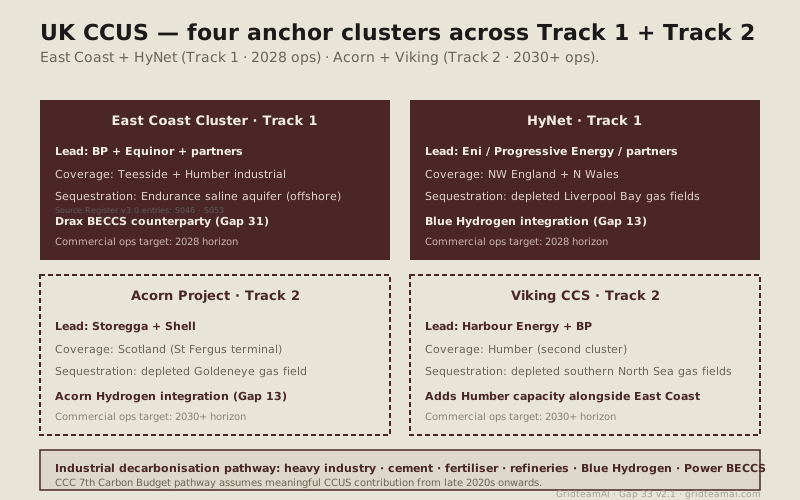
Four anchor clusters carry the UK’s industrial CO2 transport and storage.
The UK CCUS programme operates through four anchor clusters. Track 1 — East Coast Cluster (Teesside + Humber) and HyNet (NW England + N Wales). Track 2 — Acorn (Scotland) and Viking (Humber, second cluster).
The clusters are the principal operational pathway for industrial decarbonisation (heavy industry, fertiliser, cement, refineries), for Power BECCS (Drax — Gap 31) and for blue hydrogen production (HyNet + Acorn Hydrogen — Gap 13).
Track 1 commercial operations are targeted within the 2028 horizon; Track 2 within 2030+. Cluster operator commercial readiness is the gating factor — and the Drax BECCS Final Investment Decision is gated on East Coast Cluster commissioning.
The clusters are the principal route to UK industrial decarbonisation.
Sectors that cannot be electrified directly — heavy industry (steel, cement), petrochemicals and refineries, fertiliser, and large-scale hydrogen production — depend on CCUS for net-zero compatibility. The CCC pathway to net-zero by 2050 assumes a meaningful industrial CCUS contribution from the late 2020s onwards.
CO2 transport and sequestration is also the gating factor on UK negative emissions: Power BECCS at Drax (Gap 31) depends on East Coast Cluster operational readiness, and its Final Investment Decision is gated on commercial commissioning of the cluster and its transport contracts.
The volume's argument
UK CCUS is structurally important for industrial competitiveness and net-zero delivery; the operational test is whether the Track 1 clusters reach commercial operations on the 2028 horizon. Without CCUS, UK industrial sectors face a binary choice between closure and offshoring of emissions, or sustained UK emissions through 2050+.
The shape of this volume. Section 1 sets out the headline figures. Section 2 develops twelve findings, each confidence-annotated. A chapter-weight pull at p. 14 anchors the argument. Section 3 sets out the four anchor clusters. Section 4 develops the three decarbonisation pathways. Section 5 isolates the sequencing, finance and the 2028 commercial test. Section 6 makes recommendations, with a one-page tear-out at p. 25.
Executive summary · ends1 · The headline figures · p. 07
09 · FIG. 11 · The four anchor clusters · restyled -v2
1 · The headline figures09
Figure 1 · The four anchor clustersDESNZ · cluster operators
East Coast and HyNet (Track 1); Acorn and Viking (Track 2).
The four clusters anchor the UK industrial CCUS infrastructure programme — Track 1 commercial operations targeted within the 2028 horizon, Track 2 within 2030+. CO2 transport and offshore sequestration in saline aquifers and depleted gas fields.
Fig. 1 / Section 3
Track 1 (solid oxblood) leads; Track 2 (dashed) follows. Cluster geography is the route to CO2 sequestration for UK industry.
Quarterly Sector Report · Gap 332 · Twelve findings · p. 10
09 — 102 · Six findings · 01 – 04 · 2×2 grid
2 · Twelve findings on cluster delivery10
2 · Twelve findings on cluster deliveryQ1 2029
Twelve findings. Each carries a confidence level.
HIGH — verified against DESNZ, a cluster operator, the CCSA or a recognised industry body. MEDIUM — named UK industry coverage cross-referenced to a primary source. LOW — GridteamAI scenario projection or interpretation, marked as such.
Findings 01 – 12 · summary
01UK CCUS programme operates through four anchor clusters.
02East Coast Cluster anchors industrial decarbonisation at scale.
03HyNet links North West industry to offshore Liverpool Bay storage.
UK CCUS programme operates through four anchor clusters.
The UK CCUS programme is structured around four anchor industrial clusters — selected through the DESNZ cluster sequencing process to provide commercial-scale CO2 transport and sequestration infrastructure for UK industry. The Track 1 / Track 2 distinction is by selection timing and commercial maturity. Track 1 (selected 2021–2022, commercial development since 2023): East Coast Cluster (Teesside + Humber) and HyNet (NW England + N Wales). Track 2 (selected 2023, earlier commercial maturity): Acorn (Scotland) and Viking (Humber, second cluster). For industrial CO2 customers, cluster selection is the operational route to sequestration: sites within or adjacent to a cluster geography have transport pipeline and sequestration access; sites outside cluster footprints face higher capture-to-sequestration logistics costs or no operational route until further cluster expansion.
Sources · DESNZ CCUS cluster sequencing programme
Finding 02 · HIGH
East Coast Cluster anchors industrial decarbonisation at scale.
The East Coast Cluster — lead operators BP + Equinor + partners — covers the Teesside industrial complex and the Humber industrial complex, together the largest concentration of UK industrial CO2 emissions. Anchor industrial customers include refineries, fertiliser plants, cement works, hydrogen production sites, and Power BECCS at Drax (Gap 31 cross-ref). CO2 is transported via dedicated onshore and offshore pipelines to the Endurance saline aquifer — an offshore North Sea geological formation with substantial sequestration capacity. The cluster is at advanced commercial development, with commercial operations targeted within the 2028 horizon. For Drax BECCS, East Coast Cluster operational readiness is the gating factor on negative-emissions delivery (Gap 31).
Sources · East Coast Cluster operator materials · DESNZ
 GridteamAI