← GridteamAI

Purchase access

This is part of the paid GridteamAI Quarterly Sector Report.

Purchase access — book@gridteamai.com

£295 single volume · £995/yr annual · Team £2,495 · Enterprise £4,995 · Corporate £9,995. Secure checkout coming soon; email to purchase today.

GridteamAI · Quarterly Sector Report · Gap 30
UK Tidal Stream and Marine Energy — AR7a Pot 2’s deepest saving, the global lead, and the cost-down pathway, decoded
Series consistency · canonical Gap-series system
A4 · 210 × 297 mm · 3 mm bleed (not shown)
UK English · 2026 edition · v1.0
FRONT MATTERi · Cover · ink · full bleed
GridteamAI
Quarterly Sector Report
Volume Gap 30
Renewables Generation
by GridteamAI
UK · Tidal Stream · Wave · Marine Energy United Kingdom · Q2 2028

Tidal Stream
Leadership.

The deepest saving in AR7+AR7a — 20.9 MW at £265/MWh, and the UK’s global lead in tidal stream.

gridteamai.com · book@gridteamai.com 2026 edition · v1.0 Volume 3
05 — 06Executive summary · spread
UK Tidal Stream and Marine Energy · Executive summary05
00 · Executive Summary A two-page brief

The deepest saving in the round — and a global lead to scale.

AR7a Pot 2 (Tidal Stream) awarded 20.9 MW at £265.00/MWh on 10 February 2026 — a 28.57% saving against the £371 Administrative Strike, the deepest single % saving across the entire AR7 + AR7a round.

The UK is the global leader in tidal stream deployment — MeyGen (world’s largest), Orbital’s O2 (world’s most powerful floating, 2 MW), Nova’s Shetland array (world’s first commercial offshore array). EMEC Orkney is the global reference test centre.

At £265/MWh, tidal sits at the high end of the renewable cost curve — above floating wind (£216.49/MWh, Gap 28) and fixed offshore (£91.20/MWh, Gap 08) — reflecting early-stage deployment. A path to £150-180/MWh by 2030 is plausible with sustained AR allocation.

The Q2 2028 picture

GridteamAI base case: AR8 Pot 2 tidal allocation grows to 30-50 MW; UK operational tidal stream reaches 50-80 MW; the O2 floating demonstrator + first commercial follow-on in development; EMEC test capacity sustained; industry confidence rebuilding from AR7a price discovery.

The shape of this volume. Section 1 sets out the headline figures. Section 2 develops twelve findings, each confidence-annotated. A chapter-weight pull at p. 14 anchors the argument. Section 3 sets out UK marine energy leadership — MeyGen, O2, Shetland, EMEC. Section 4 covers AR7a and the cost-down pathway. Section 5 covers tidal vs wave and the forward pathway. Section 6 makes recommendations, with a one-page tear-out at p. 25.

Executive summary · ends1 · The headline figures · p. 07
09 · FIG. 11 · AR7a Pot 2 — the deepest saving · restyled -v2
1 · The headline figures09
Figure 1 · AR7a Pot 2 — the deepest savingDESNZ AR7a · 10 Feb 2026

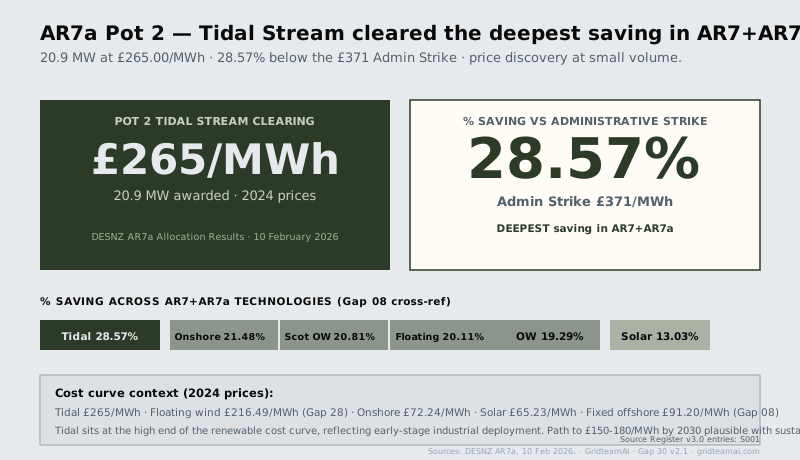
20.9 MW at £265/MWh — a 28.57% saving, the deepest in AR7+AR7a.

Tidal stream cleared the deepest single percentage saving against an Administrative Strike across the whole round. Modest volume, material cost discovery — and tidal sits at the high end of the renewable cost curve, with a plausible path to £150-180/MWh by 2030.

AR7a Pot 2 tidal stream cleared the deepest saving in the AR7+AR7a round: 20.9 MW awarded at £265 per MWh in 2024 prices, a 28.57% saving against the £371 Administrative Strike. A six-bar comparator ranks the percentage savings across AR7+AR7a technologies — tidal 28.57% (moss) highest, then onshore wind 21.48%, Scottish offshore 20.81%, floating wind 20.11%, offshore wind 19.29% and solar 13.03% (neutral). A footer gives cost-curve context: tidal £265/MWh, floating wind £216.49/MWh, fixed offshore £91.20/MWh, with a plausible path to £150-180/MWh by 2030 with sustained AR allocation.
Fig. 1 / Section 1

Tidal’s 28.57% saving (moss) is the deepest in the round; the comparator bars (neutral) sit lower. 20.9 MW at £265/MWh — material price discovery at small volume.

Quarterly Sector Report · Gap 302 · Twelve findings · p. 10
09 — 102 · Twelve findings · 01 – 03
2 · Twelve findings on UK marine energy10
2 · Twelve findings on UK marine energyQ2 2028

Twelve findings. Each carries a confidence level.

HIGH — verified against DESNZ, EMEC, a named developer or recognised industry body. MEDIUM — named UK industry coverage cross-referenced to a primary source. LOW — GridteamAI scenario projection, marked as such.

Findings 01 – 12 · summary

  1. 01AR7a Pot 2 delivered material price discovery at modest volume — the deepest saving in the round.
  2. 02MeyGen is the world’s largest operating tidal stream project.
  3. 03Orbital Marine Power’s O2 is the world’s most powerful floating tidal generator.
  4. 04Nova Innovation supplies Shetland’s grid — the world’s first commercial offshore tidal array.
  5. 05EMEC Orkney remains the global reference test centre.
  6. 06Wave energy is structurally behind tidal stream on UK commercial scale-up.
  7. 07The marine energy port + supply chain interface shares infrastructure with offshore wind.
  8. 08Crown Estate Scotland operates the marine seabed leasing framework.
  9. 09NWF + GBE are positioned for commercial-scale marine energy participation.
  10. 10AR8 + AR9 Pot 2 allocation is the operational variable.
  11. 11Three plausible scenarios bracket the Q2 2028 picture.
  12. 12Implications for developers, EMEC, supply chain and Government.

Findings 01 – 09 follow in detail · pp. 10 – 12 · 10 – 12 summarised on the matrix

Quarterly Sector Report · Gap 302
112 · Findings 01 – 03
2 · Findings 01 — 03AR7a · MeyGen · the O2
Finding 01 · HIGH

AR7a Pot 2 delivered material price discovery at modest volume.

DESNZ’s AR7a allocation (results published 10 February 2026) awarded 20.9 MW of tidal stream at £265.00/MWh in 2024 prices — a 28.57% saving against the £371/MWh Pot 2 Administrative Strike Price. The 28.57% saving is the deepest single % saving across the entire AR7 + AR7a allocation round (offshore wind 19.29%; Scotland 20.81%; floating 20.11%; solar 13.03%; onshore 21.48%). The 20.9 MW volume is modest, but the % saving signals competitive bidding among a small developer pool — Pot 2 oversubscribed at the Administrative Strike. Tidal stream is competitively bankable below the strike, even at small-scale deployment.

Finding 02 · HIGH

MeyGen is the world’s largest operating tidal stream project.

The MeyGen tidal stream array in the Pentland Firth — operated by SAE Renewables — is the world’s largest operating tidal stream project. MeyGen Phase 1 commissioned 6 MW (four 1.5 MW Andritz Hydro Hammerfest turbines); additional capacity is in development under Phase 1B and Phase 2. The Pentland Firth — the strait between Caithness and Orkney — is the highest tidal energy density site in UK waters and one of the highest globally. MeyGen demonstrates that UK + Scottish tidal stream technology has reached operational maturity for industrial deployment in suitable high-tidal-flow sites.

Finding 03 · HIGH

Orbital Marine Power’s O2 is the world’s most powerful floating tidal generator.

Orbital Marine Power’s O2 floating tidal turbine — moored at EMEC’s Fall of Warness test site in Orkney — is the world’s most powerful operating floating tidal generator at 2 MW. The O2 represents a different deployment architecture from MeyGen’s seabed-mounted turbines: floating deployment opens significantly larger commercial sites with deeper water, less restrictive bathymetry, and potentially lower installation costs. Orbital is positioned for commercial-scale floating tidal projects pending the AR allocation pathway + Crown Estate Scotland marine seabed leasing. The O2 demonstrator and planned follow-on deployments are central to the UK floating tidal proposition.

2 · 01 – 03Findings 04 – 06 · facing