Dormant 42 years — now a regulated infrastructure asset class.
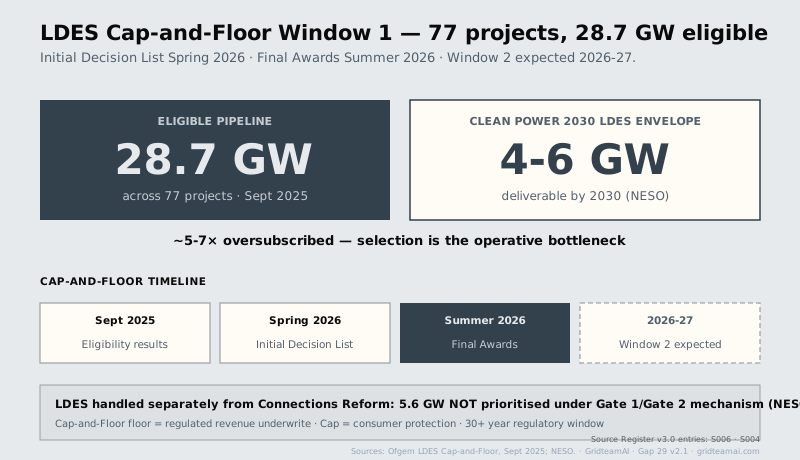
The Ofgem LDES Cap-and-Floor scheme published Window 1 eligibility in September 2025: 77 projects, 28.7 GW. Against a Clean Power 2030 deliverable envelope of 4–6 GW, the pipeline is ~5-7× oversubscribed — selection, not technology readiness, is the bottleneck.
Coire Glas (SSE Renewables, 1.4 GW) is the UK’s largest single Cap-and-Floor-eligible pumped hydro project — the first major scheme since Dinorwig in 1984. Earba (Gilkes/SSE JV, 1.8 GW indicative) is the second-largest. Combined, 3.2 GW — about half the deliverable 2030 envelope.
The Cap-and-Floor mechanism mirrors the regulated-asset logic of transmission and water: a revenue floor de-risks the equity case, a cap protects consumers. With 80-100+ year asset lives, pumped hydro becomes long-life regulated infrastructure — not the merchant-storage class it would have been pre-2025.
GridteamAI · Quarterly Sector Report · Gap 29UK
06Executive summary · continued
A regulated asset class with 30+ year visibility — and a 42-year-dormant supply chain to reset.
The 28.7 GW eligible pipeline is heavily concentrated in Scotland — reflecting elevation differential, water availability and Scottish Government policy support. Coire Glas (1.4 GW), Earba (1.8 GW), Loch na Cathrach, the Cruachan expansion (Drax) and Statkraft + ILI Group projects lead. English and Welsh projects are smaller and fewer.
The Q1 2028 picture
Base case: Cap-and-Floor Window 1 final awards complete (7-12 projects cleared); Coire Glas + Earba at or near financial close; 2-3 projects in active construction; Window 2 design published with extended eligibility; the pipeline maturing toward 4-5 GW deliverable by 2030.
The shape of this volume. Section 1 sets out the headline figures. Section 2 develops twelve findings, each confidence-annotated. A chapter-weight pull at p. 14 anchors the argument. Section 3 sets out the Cap-and-Floor regime. Section 4 maps the Coire Glas + Earba pipeline. Section 5 sets out BESS-vs-LDES complementarity and the outlook. Section 6 makes recommendations, with a one-page tear-out at p. 25.
Executive summary · ends1 · The headline figures · p. 07
28.7 GW eligible against a 4-6 GW envelope — ~5-7× oversubscribed.
Window 1 found 77 projects, 28.7 GW eligible (Sept 2025); Initial Decision List Spring 2026, Final Awards Summer 2026, Window 2 expected 2026-27. LDES is handled separately from Connections Reform — 5.6 GW not prioritised under Gate 1/Gate 2.
Fig. 1 / Section 1
The 28.7 GW eligible bar (steel) towers over the 4-6 GW deliverable envelope. Selection between eligible projects is the bottleneck, not technology readiness.
Quarterly Sector Report · Gap 292 · Twelve findings · p. 10
09 — 102 · Six findings · 01 – 04 · 2×2 grid
2 · Twelve findings on UK pumped hydro10
2 · Twelve findings on UK pumped hydroQ1 2028
Twelve findings. Each carries a confidence level.
HIGH — verified against Ofgem, DESNZ, a named developer or recognised industry body. MEDIUM — named industry coverage cross-referenced to a primary source. LOW — GridteamAI scenario projection, marked as such.
Findings 01 – 12 · summary
01LDES Cap-and-Floor unlocked the regulated investment case for long-duration storage.
02Coire Glas (SSE Renewables, 1.4 GW) is the UK’s first major new pumped hydro in 42 years.
03Earba (Gilkes / SSE JV, 1.8 GW) is the second-largest eligible project.
05LDES capacity is handled separately from BESS Connections Reform.
06Scottish geography concentrates the eligible pipeline.
07Grid transmission interaction is a structural delivery factor.
08Pumped hydro complements BESS, not competes — different system roles.
09Cap-and-Floor Window 2 extends the opportunity into 2026-27.
10Public finance and Scottish industrial strategy interact.
11The Q1 2028 outlook depends on Cap-and-Floor delivery.
12Implications for developers, investors, supply chain and Government.
Findings 01 – 09 follow in detail · pp. 10 – 14 · 10 – 12 summarised on the matrix
Quarterly Sector Report · Gap 292
112 · Findings 01 – 03
2 · Findings 01 — 03The regulated case · Coire Glas · Earba
Finding 01 · HIGH
LDES Cap-and-Floor unlocked the regulated investment case for long-duration storage.
Ofgem’s LDES Cap-and-Floor scheme converted long-duration storage from a theoretically attractive but commercially unviable asset class into a regulated investment opportunity. The mechanism: a revenue floor (under-recovery filled by allowed revenue) plus a revenue cap (over-recovery returned to consumers) over the project’s regulated life. The floor de-risks the equity case; the cap protects consumers against monopoly-rent capture. Window 1 eligibility (September 2025) found 77 projects across 28.7 GW; Initial Decision List Spring 2026, Final Awards Summer 2026. The 28.7 GW eligible vastly exceeds the 4-6 GW deliverable pre-2035 envelope — selection between eligible projects, not technology readiness, is the operative bottleneck.
Finding 02 · HIGH
Coire Glas (SSE Renewables) is the UK’s first major new pumped hydro in 42 years.
SSE Renewables’ Coire Glas project — 1.4 GW capacity, at Loch Lochy in the Scottish Highlands — is the UK’s largest single Cap-and-Floor-eligible pumped hydro project. Planning consent is secured; site investigation complete; financial close pending Cap-and-Floor award. The 1.4 GW figure is canonical across the GridteamAI v2.x catalogue (standardised in Gap 17 from the 1.4-1.45 GW range in earlier coverage). Coire Glas represents the first major UK pumped hydro commissioning since Dinorwig in 1984 — a 42-year gap reflecting four decades of unfavourable regulatory and market conditions for the asset class.
Finding 03 · MEDIUM
Earba (Gilkes / SSE JV) is the second-largest eligible project.
The Earba pumped hydro project — a joint venture between Gilkes Energy and SSE Renewables — sits at 1.8 GW indicative capacity, at advanced development stage with planning, grid connection and Cap-and-Floor eligibility in progress. Combined, Coire Glas + Earba constitute 3.2 GW of UK pumped hydro pipeline alone — approximately half of the deliverable 2030 LDES envelope. SSE Renewables’ position across both projects, plus interests in additional smaller pumped-hydro schemes, makes the company the single largest UK long-duration storage developer.
 GridteamAI