← GridteamAI

Purchase access

This is part of the paid GridteamAI Quarterly Sector Report.

Purchase access — book@gridteamai.com

£295 single volume · £995/yr annual · Team £2,495 · Enterprise £4,995 · Corporate £9,995. Secure checkout coming soon; email to purchase today.

GridteamAI · Quarterly Sector Report · Gap 28
UK Floating Offshore Wind — ~17 GW leased, the Celtic Sea + Scottish pipeline and the floating supply chain, decoded
Series consistency · canonical Gap-series system
A4 · 210 × 297 mm · 3 mm bleed (not shown)
UK English · 2026 edition · v1.0
FRONT MATTERi · Cover · ink · full bleed
GridteamAI
Quarterly Sector Report
Volume Gap 28
Renewables Generation
by GridteamAI
UK · Floating Offshore Wind · Crown Estate Leasing United Kingdom · Q4 2027

UK Floating
Offshore Wind.

~17 GW of seabed leased, 192.5 MW awarded — the world’s largest floating wind portfolio, at pilot-to-commercial transition.

gridteamai.com · book@gridteamai.com 2026 edition · v1.0 Volume 1
05 — 06Executive summary · spread
UK Floating Offshore Wind · Executive summary05
00 · Executive Summary A two-page brief

~17 GW of seabed leased, 192.5 MW awarded — the scale-up question.

The Crown Estate’s Celtic Sea Round 5 awarded 4.5 GW of floating wind seabed across three project areas in 2024 — the first commercial-scale floating wind tender globally. Crown Estate Scotland’s INTOG + ScotWind floating subset commit a further 12+ GW.

AR7 (results 14 January 2026) awarded 192.5 MW of floating wind at £216.49/MWh in 2024 prices — a 20.11% saving against the £271 administrative strike, and the first commercial-scale UK floating price discovery. It is approximately 1.1% of the leased pipeline.

Round 5 awarded 4.5 GW of Celtic Sea floating wind (3 × 1.5 GW) to Equinor, Gwynt Glas and Ocean Winds — but at £216.49/MWh, floating sits ~2.4× the £91.20/MWh fixed-bottom strike (Gap 08). Closing that premium toward £130-150/MWh by 2030 is the scale-up question.

The Q4 2027 picture

GridteamAI base case: ~3-5 GW floating wind operational or in construction; the three Celtic Sea Round 5 floating sites (up to 4.5 GW), under agreements for lease by October 2026 and moving on to surveys and planning; AR8 floating allocation 500-1,000 MW at £180-200/MWh; first Welsh + Scottish port industrial commitments confirmed. ~10-12 GW by 2030 against the 17 GW leased pipeline.

The shape of this volume. Section 1 sets out the headline figures. Section 2 develops twelve findings, each confidence-annotated. A chapter-weight pull at p. 14 anchors the argument. Section 3 sets out the two leasing systems — Celtic Sea Round 5 vs the Scottish portfolio. Section 4 covers AR7 and the cost-down pathway. Section 5 covers ports and the supply chain. Section 6 makes recommendations, with a one-page tear-out at p. 25.

Executive summary · ends1 · The headline figures · p. 07
09 · FIG. 11 · The ~17 GW leased pipeline · restyled -v2
1 · The headline figures09
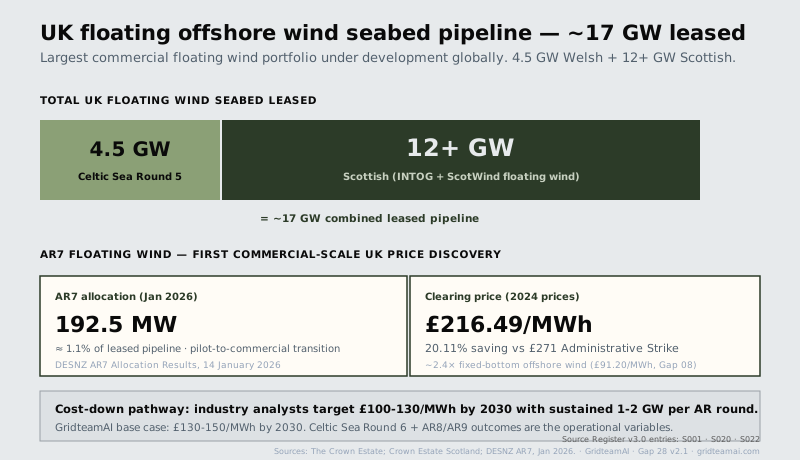
Figure 1 · The ~17 GW leased pipelineCrown Estate · CES · DESNZ AR7

~17 GW of seabed leased; 192.5 MW awarded at £216.49/MWh.

4.5 GW Celtic Sea + 12+ GW Scottish = ~17 GW combined leased pipeline — the largest under development globally. AR7 awarded 192.5 MW (≈1.1% of the pipeline) at £216.49/MWh, ~2.4× the fixed-bottom strike. The cost-down pathway to £130-150/MWh by 2030 is the operational variable.

UK floating offshore wind seabed pipeline of about 17 GW leased, shown as a stacked bar: 4.5 GW Celtic Sea Round 5 (Welsh, lighter moss) plus 12+ GW Scottish INTOG and ScotWind floating wind (full moss), totalling about 17 GW combined — the largest commercial floating wind portfolio under development globally. Below, AR7 floating wind price discovery: 192.5 MW awarded in January 2026, about 1.1% of the leased pipeline, at a clearing price of £216.49 per MWh, a 20.11% saving against the £271 administrative strike and roughly 2.4 times the £91.20 fixed-bottom price. A footer notes the cost-down pathway: industry analysts target £100-130/MWh by 2030, GridteamAI base case £130-150/MWh, with the Celtic Sea round (Round 5) and AR8/AR9 outcomes the operational variables.
Fig. 1 / Section 1

The Scottish portfolio (full moss) dwarfs the Welsh (light moss); together ~17 GW. AR7’s 192.5 MW is ~1.1% of the leased pipeline.

Quarterly Sector Report · Gap 282 · Twelve findings · p. 10
09 — 102 · Twelve findings · 01 – 03
2 · Twelve findings on UK floating offshore wind10
2 · Twelve findings on UK floating offshore windQ4 2027

Twelve findings. Each carries a confidence level.

HIGH — verified against The Crown Estate, Crown Estate Scotland, DESNZ, devolved government or recognised industry-body primary source. MEDIUM — named UK industry coverage cross-referenced to a primary source. LOW — GridteamAI scenario projection, marked as such.

Findings 01 – 12 · summary

  1. 01Celtic Sea Round 5 is the world’s first commercial-scale floating wind tender.
  2. 02The Scottish floating wind seabed portfolio is materially larger — 12+ GW.
  3. 03AR7 awarded 192.5 MW at £216.49/MWh — material price discovery, modest volume.
  4. 04The fixed-bottom comparator (£91.20/MWh) highlights the ~2.4× scale-up requirement.
  5. 05Welsh + Scottish port readiness is the principal supply-chain constraint.
  6. 06Dynamic cable, mooring and anchoring supply chain is import-dependent.
  7. 07Grid transmission interaction is structurally significant — EGL for Scotland.
  8. 08Welsh Marine Plan integration is operative for Round 5 and Round 6.
  9. 09Floating wind interacts with the NWF + GBE public-finance stack.
  10. 10The forward outlook depends on Round 6 design + the AR8/AR9 strike pathway.
  11. 11Three plausible scenarios bracket the Q4 2027 picture.
  12. 12Implications for developers, supply chain, ports and Government.

Findings 01 – 09 follow in detail · pp. 10 – 12 · 10 – 12 summarised on the matrix

Quarterly Sector Report · Gap 282
112 · Findings 01 – 03
2 · Findings 01 — 03The estate · the Bill · the consensus
Finding 01 · HIGH

Celtic Sea Round 5 is the world’s first commercial-scale floating wind tender.

The Crown Estate’s Celtic Sea Round 5 leasing process awarded 4.5 GW of floating offshore wind seabed rights across three project areas in 2024 — the first commercial-scale floating wind tender globally. The three project areas sit off South Wales and South West England within the Welsh Government marine plan framework (Gap 16). The leasing model — Crown Estate selecting developer consortia through a competitive process, with seabed rights conditional on grid connection, planning consent and financial-close milestones — is the template most likely to be replicated for Round 6. The 4.5 GW envelope is consistent with the Welsh Marine Plan’s strategic allocation; it does not exhaust available Welsh seabed but represents the first commercial wave.

Finding 02 · HIGH

The Scottish floating wind seabed portfolio is materially larger — 12+ GW.

Crown Estate Scotland’s INTOG (Innovation and Targeted Oil and Gas decarbonisation) round and the ScotWind floating-wind subset together commit 12+ GW of Scottish floating wind seabed. INTOG specifically targets floating wind providing power to oil + gas platforms — a transitional decarbonisation use case; ScotWind floating projects target conventional grid connection. The combined Scottish portfolio is approximately 2-3× the Welsh portfolio. Project geography concentrates in the outer Moray Firth, the Northern Isles approaches and the West of Shetland zone — locations whose grid connections depend on the Eastern Green Link programme (Gap 11) and broader Scottish transmission reinforcement.

Finding 03 · HIGH

AR7 awarded 192.5 MW at £216.49/MWh — material price discovery, modest volume.

DESNZ’s AR7 allocation (results published 14 January 2026) awarded 192.5 MW of floating offshore wind at £216.49/MWh in 2024 prices — a 20.11% saving against the £271 Administrative Strike Price. The clearing price is the first published commercial-scale UK floating wind strike and serves as price discovery for AR8 and subsequent rounds. The 192.5 MW award represents approximately 1.1% of the leased Celtic Sea + Scottish floating wind seabed pipeline. Floating wind is at pilot-to-commercial transition, not industrial scale-up. AR8 + AR9 outcomes will be the operational test of whether the sector can absorb materially larger CfD allocations within commercially viable strike-price envelopes.

2 · 01 – 03Findings 04 – 06 · facing