UK Answer to the Inflation Reduction Act · Executive summary05
00 · Executive SummaryA two-page brief
The UK could not match the IRA on scale — so it answered structurally.
The US Inflation Reduction Act (Aug 2022) was the largest single climate-and-industrial intervention by any G7 economy in recent history — several hundred billion dollars of tax credits. The UK could not match it on fiscal scale.
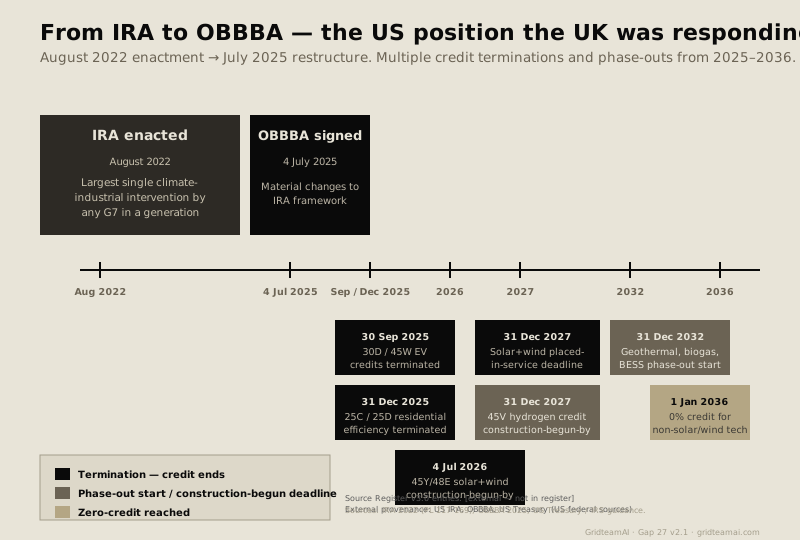
On 4 July 2025 the OBBBA restructured the IRA — terminating 45Y/48E for solar and wind (construction begun on/after 4 Jul 2026, placed-in-service after 31 Dec 2027), restricting 45V hydrogen, ending 30D/45W EV credits, and adding foreign-entity restrictions.
UK energy-transition investment fell 10% in 2023 while the US rose 24% and Germany 17% — the wake-up call. The UK answer is structural: ~£40bn direct public commitment and a £100bn mobilisation target, delivered through the institutional stack of the preceding 26 reports.
A different theory of policy: structural certainty in place of fiscal generosity.
The UK answer is delivered through the institutional and regulatory stack of the preceding 26 reports: regulated revenue (CfD, LDES Cap-and-Floor), regulatory reform (Connections Reform, the NSIP route), public-finance institutions (NWF £27.8bn, GBE £8.3bn), the Industrial Strategy 2025 (£2bn industrial electricity, £500m quantum), and supply-chain and workforce investment (Critical Minerals Strategy, Clean Energy Jobs Plan).
The post-OBBBA US position has, perhaps unintentionally, made the UK more relatively competitive: projects that would have been bankable under the original IRA may no longer fit the OBBBA framework, and capital seeking stable regulatory regimes may redirect toward the UK, EU and other markets.
The volume's argument
The UK's structural-not-fiscal approach is necessarily the right approach given UK fiscal constraints. The question is whether execution discipline delivers Clean Power 2030 outcomes on the same timetable that IRA-funded projects would have done. As the final Tranche 1 report, this volume frames the UK's institutional response as a coherent — if imperfectly executed — alternative to the IRA model.
The shape of this volume. Section 1 sets out the headline figures. Section 2 develops twelve findings, each confidence-annotated. A chapter-weight pull at p. 14 anchors the argument. Section 3 sets out the IRA and the OBBBA restructure. Section 4 develops the UK structural response and the Industrial Strategy 2025. Section 5 isolates the post-OBBBA opportunity and the 2030 delivery test. Section 6 makes recommendations, with a one-page tear-out at p. 25.
Executive summary · ends1 · The headline figures · p. 07
09 · FIG. 11 · From IRA to OBBBA timeline · restyled -v2
1 · The headline figures09
Figure 1 · From IRA to OBBBAIRA 2022 · OBBBA 2025 · IRS
The US position the UK was responding to changed.
August 2022 IRA enactment → 4 July 2025 OBBBA restructure: solar/wind, hydrogen, EV and residential credits terminated or phased out from 2025 through 2036. The IRA in force is materially different from the one the UK first answered.
Fig. 1 / Section 3
IRA enactment (walnut) → OBBBA restructure (ink). The comparative baseline the UK was answering has shifted.
Quarterly Sector Report · Gap 272 · Twelve findings · p. 10
09 — 102 · Six findings · 01 – 04 · 2×2 grid
2 · Twelve findings on the comparative position10
2 · Twelve findings on the comparative positionQ2 2030
Twelve findings. Each carries a confidence level.
HIGH — verified against a US Government, UK Government, regulatory or recognised think-tank primary source. MEDIUM — named law-firm, analytics or trade-press source cross-referenced to a primary source. LOW — GridteamAI scenario projection or interpretation, marked as such.
Findings 01 – 12 · summary
01The IRA was the largest single climate-and-industrial-policy intervention in a generation.
02The IRA induced a structural redirection of global clean energy capital toward the US.
03The OBBBA fundamentally restructured the IRA framework.
04The UK approach was always structural, not fiscal.
05The 10% UK investment fall in 2023 was the wake-up call.
06The UK Industrial Strategy 2025 is the operative comparative framework.
07The OBBBA changes create UK opportunity.
08The supply-chain dimension of the IRA was the most-emulated UK element.
09The relative-scale arithmetic remains adverse to the UK.
10The Q2 2030 outlook depends on Clean Power 2030 delivery.
11The Tranche 1 series itself frames a coherent UK story.
12Implications for UK competitiveness, investors and policy.
Findings 01–06 in detail · pp. 11–13 · 07–12 summarised above
Quarterly Sector Report · Gap 272
112 · Findings 01 – 02
2 · Findings 01 — 02The IRA scale · the capital redirection
Finding 01 · HIGH
The IRA was the largest single climate-and-industrial intervention in a generation.
The Inflation Reduction Act, enacted by the US Congress in August 2022, was the largest single climate-and-industrial-policy intervention by any G7 economy in recent history. Its principal mechanisms were a comprehensive expansion of clean-energy tax credits through the US Internal Revenue Code: Section 45Y (Production Tax Credit for clean electricity, technology-neutral from 2025), 48E (Clean Electricity Investment Tax Credit), 45V (Clean Hydrogen Production Credit), 45Q (carbon capture), 30D (consumer EV), 45W (commercial EV), 45X (advanced manufacturing) and the 25C/25D/45L residential credits. The gross fiscal commitment was scored from $369 billion at enactment (CBO original) to over $1 trillion (later revisions and external scoring), reflecting that several credits are technology-neutral, transferable and uncapped, with uptake substantially exceeding original projections. The IRA was unprecedented in scale and structure within G7 climate policy, and immediately reshaped the global competition for clean energy investment.
Sources · IRA 2022 (PL 117-169) · US CBO · academic scoring
Finding 02 · HIGH
The IRA induced a structural redirection of global clean energy capital toward the US.
The structural effect of the IRA between 2022 and 2025 was substantial. US energy-transition investment rose by approximately 24% in 2023 (the first full IRA year); German investment rose ~17%; UK investment fell ~10%. The redirection reflected three structural advantages: scale (the absolute size of the credit programme created bankable revenue certainty for project-finance debt, accelerating US deployment); technology neutrality (45Y/48E in their post-2025 technology-neutral form levelled the playing field for technologies that did not previously qualify); and transferability (IRA credits could be transferred between taxpayers, creating secondary monetisation markets and broadening the capital pool). The combined effect was that US clean energy projects became materially more bankable than equivalent UK and European projects. This was the strategic challenge to the UK build-out: not that the UK lacked a strategy, but that US fiscal generosity made comparable UK projects relatively less attractive to internationally mobile capital.
 GridteamAI