£295 single volume · £995/yr annual · Team £2,495 · Enterprise £4,995 · Corporate £9,995. Secure checkout coming soon; email to purchase today.
GridteamAI · Quarterly Sector Report · Gap 26
The UK Infrastructure Skills Gap: Workforce for Clean Power 2030 and Beyond — 440,000 to 860,000 by 2030, the 81% hiring signal, the trade-tier constraint
et
Series consistency · canonical Gap-series system
A4 · 210 × 297 mm · 3 mm bleed (not shown)
UK English · ~30 pp · v2.1 / Q4 2029
The UK Infrastructure Skills Gap · Executive summary05
00 · Executive SummaryA two-page brief
440,000 today, 860,000 by 2030 — a near-doubling of the clean energy workforce.
DESNZ’s Clean Energy Jobs Plan (October 2025) projects clean energy sector employment growing from approximately 440,000 in 2023 to 860,000 by 2030 — a near-doubling, ~95% growth, in seven years.
The ECITB estimates the engineering-construction workforce at 114,000 in 2025 (up from 101,000 in 2023), rising to 135,000+ by 2030 — and forecasts 40,000 additional workers needed for major projects by 2030. 81% of renewables employers report hiring difficulty.
The policy response combines a £625m Construction Skills Package (up to 60,000 workers), a £100m Engineering Skills Package, 5 Clean Energy TECs, 10 Construction TECs and Apprenticeship Levy reforms. Skills England identifies 31 priority occupations — concentrated at the trade and technician tier.
The constraint is at the trade and technician tier — not the graduate-engineer tier.
The most-in-demand occupations are mechanical fitters, electrical technicians, process engineers, project managers, pipefitters, welders and design technicians — predominantly trade and technician roles. The FE-college, apprenticeship and trade-training system is therefore more critical to delivery than the university engineering programme; the £625m Construction Skills Package and 10 Construction TECs are appropriately targeted at this tier.
The existing workforce is also structurally older than the UK working-age average — many ECI specialisms have a median age in the late 40s or early 50s — so substantial retirements over 2026–2035 compound the supply challenge. The 40,000 additional workers needed is incremental; replacing retirees is a parallel requirement.
The volume's argument
Clean Power 2030 delivery is now formally workforce-constrained, not capital-constrained. Without workforce delivery, the rest of the Tranche 1 framework — Connections Reform, Cap-and-Floor, planning reform, the public-finance stack — cannot translate into deployed infrastructure on the 2030 timetable. The constraint has been identified and funded; the Q4 2029 outcome depends on execution discipline against a moving demand target.
The shape of this volume. Section 1 sets out the headline figures. Section 2 develops twelve findings, each confidence-annotated. A chapter-weight pull at p. 14 anchors the argument. Section 3 sets out the Clean Energy Jobs Plan and the ECITB census. Section 4 develops the priority occupations and the policy response. Section 5 isolates demographics, clusters and the forward outlook. Section 6 makes recommendations, with a one-page tear-out at p. 25.
Executive summary · ends1 · The headline figures · p. 07
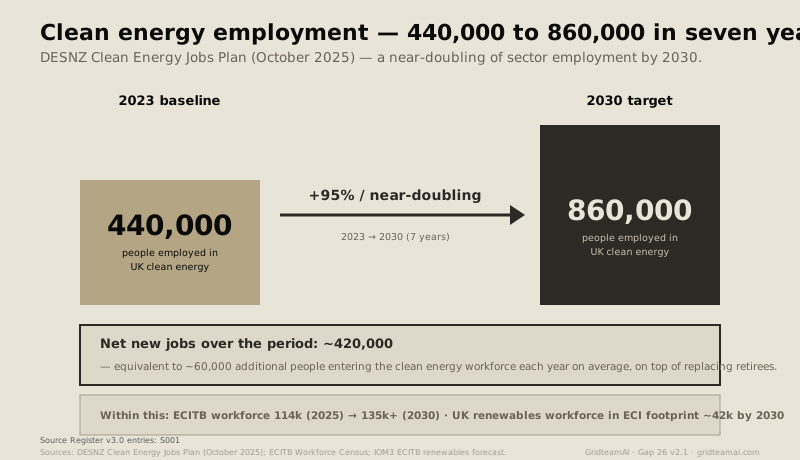
Figure 1 · Clean energy employment 440k → 860kDESNZ Clean Energy Jobs Plan
A near-doubling of the clean energy workforce in seven years.
DESNZ projects clean energy sector employment growing from ~440,000 in 2023 to ~860,000 by 2030 — ~420,000 net new jobs, about 60,000 a year, on top of replacing retirees.
Fig. 1 / Section 3
The 2030 target bar (walnut) is nearly double the 2023 baseline. ~60,000 new entrants a year, before replacing retirees.
Quarterly Sector Report · Gap 262 · Twelve findings · p. 10
09 — 102 · Six findings · 01 – 04 · 2×2 grid
2 · Twelve findings on the workforce constraint10
2 · Twelve findings on the workforce constraintQ4 2029
Twelve findings. Each carries a confidence level.
HIGH — verified against a UK Government department, Skills England, ECITB, Parliamentary or professional-institution primary source. MEDIUM — named industry analytics or trade-press source cross-referenced to a primary source. LOW — GridteamAI scenario projection or interpretation, marked as such.
Findings 01 – 12 · summary
01The Clean Energy Jobs Plan is the operative UK workforce strategy.
02The ECITB Workforce Census quantifies the skills shortage operationally.
03The most-in-demand occupations are the trade and technician tier.
04The £625m Construction Skills Package is the largest single intervention.
05The 5 Clean Energy Technical Excellence Colleges are the targeted infrastructure.
06Apprenticeship Levy reforms add flexibility and foundation pathways.
07The age profile is structurally older — a slow-moving demographic challenge.
08Data centre construction skills are a distinct emerging category.
09Geographic skills supply must match the uneven cluster geography.
10Diversity, inclusion and just transition are operational, not aspirational.
11The Q4 2029 outlook depends on training-pipeline maturity.
12Implications for employers, training providers, policymakers and Government.
Findings 01–06 in detail · pp. 11–13 · 07–12 summarised above
Quarterly Sector Report · Gap 262
112 · Findings 01 – 02
2 · Findings 01 — 02The Jobs Plan · the ECITB census
Finding 01 · HIGH
The Clean Energy Jobs Plan is the operative UK workforce strategy.
DESNZ’s Clean Energy Jobs Plan, published October 2025, is the operative UK workforce strategy for the clean energy and net zero transition. It projects clean energy sector employment growing from approximately 440,000 in 2023 to 860,000 by 2030 — a near-doubling in seven years. The Plan is structured around five pillars: skills supply, regional cluster development, industrial-strategy alignment, apprenticeship and qualifications reform, and just-transition arrangements, explicitly cross-departmental across DESNZ, DfE, DBT and the devolved administrations. Three features matter: quantified targets stated as binding (the 440k→860k trajectory and the £625m/£100m funding); cluster geography (the five Clean Energy TECs co-located with Clean Power 2030 delivery clusters, consistent with the AI Growth Zone strategy, Gap 18); and genuine cross-departmental alignment — a meaningful improvement on the historic pattern of fragmented skills policy.
Sources · DESNZ Clean Energy Jobs Plan (Oct 2025) · FE Week
Finding 02 · HIGH
The ECITB Workforce Census quantifies the skills shortage operationally.
The Engineering Construction Industry Training Board (ECITB) Workforce Census is the most-cited published quantification of the ECI skills shortage. The 2025 Census records the ECI workforce at 114,000 (up from 101,000 in 2023), rising to more than 135,000 by 2030 (19% growth), with 40,000 additional workers required by 2030 for major projects, and 81% of renewables employers experiencing hiring challenges. The 81% figure is the most operationally consequential single number — the gap between vacancies posted and posts filled. The implication is not that hiring is impossible; it is that hiring is materially slower and more expensive than employers would prefer, with downstream consequences for project cost and timetable. For developers it translates into elevated wage cost, extended recruitment timetables, greater reliance on contractor labour pools, and acute exposure at specialist roles (HVDC commissioning engineers, offshore-wind specialists, nuclear-qualified welders).
 GridteamAI