£295 single volume · £995/yr annual · Team £2,495 · Enterprise £4,995 · Corporate £9,995. Secure checkout coming soon; email to purchase today.
GridteamAI · Quarterly Sector Report · Gap 25
UK Critical Minerals and the Grid: Supply Chain Exposure of the Net Zero Build-Out — 6% domestic today, the 30% 2035 target, the HVDC concentration risk
target
Series consistency · canonical Gap-series system
A4 · 210 × 297 mm · 3 mm bleed (not shown)
UK English · ~30 pp · v2.1 / Q1 2029
UK Critical Minerals and the Grid · Executive summary05
00 · Executive SummaryA two-page brief
6% domestic today, a 30% target by 2035, a 34-mineral critical list.
The Vision 2035 Critical Minerals Strategy targets lifting the UK’s domestic share of critical-mineral needs from approximately 6% today to 30% by 2035 — a fivefold expansion of domestic mining and recycling against a denominator that is itself rising sharply.
The Strategy introduces binding targets: 10% domestic production, 20% recycling, and a maximum 60% reliance on any single foreign supplier for each mineral — supported by up to £50 million of funding for UK extraction, refining, processing and recycling.
By 2035, annual UK demand for copper will approximately double and demand for lithium will rise by approximately 1,100% (a 12-fold increase). The Eastern Green Link programme illustrates the materials concentration: EGL1 alone awarded £1.8 billion of contracts, with raw materials 70–80% of overhead-cable cost.
Domestic production, recycling and procurement diplomacy — three legs of one Strategy.
The 30% target splits into 10% domestic production + 20% recycling, with a 60% single-supplier cap as the third leg. Recycling is the larger and more tractable half — battery recycling (lithium, cobalt, nickel, graphite) is at industrial scale globally and being established in the UK. Domestic production (Cornish Lithium, British Lithium, Pensana) is emerging but small against the requirement.
The HVDC supply chain — cables, converter stations, transformers — is concentrated in approximately 5–6 manufacturers globally (Prysmian, Nexans, NKT, Hitachi Energy, Siemens Energy, GE Vernova). UK domestic capacity is modest; the GBE Supply Chain Fund (£300m, Gap 24) is one lever to build it.
The volume's argument
UK Clean Power 2030 and 2035 delivery depends on a critical-minerals supply chain that has been historically import-dependent. The Critical Minerals Strategy is necessary but not sufficient; matching industrial policy, public-finance support and international procurement diplomacy are operationally complementary. The policy response is in place; the execution discipline matters.
The shape of this volume. Section 1 sets out the headline figures. Section 2 develops twelve findings, each confidence-annotated. A chapter-weight pull at p. 14 anchors the argument. Section 3 sets out the Vision 2035 Strategy and the BGS list. Section 4 develops the demand trajectories and the HVDC supply chain. Section 5 isolates the domestic build-out and the forward outlook. Section 6 makes recommendations, with a one-page tear-out at p. 25.
Executive summary · ends1 · The headline figures · p. 07
A fivefold expansion of domestic supply — 10% production, 20% recycling.
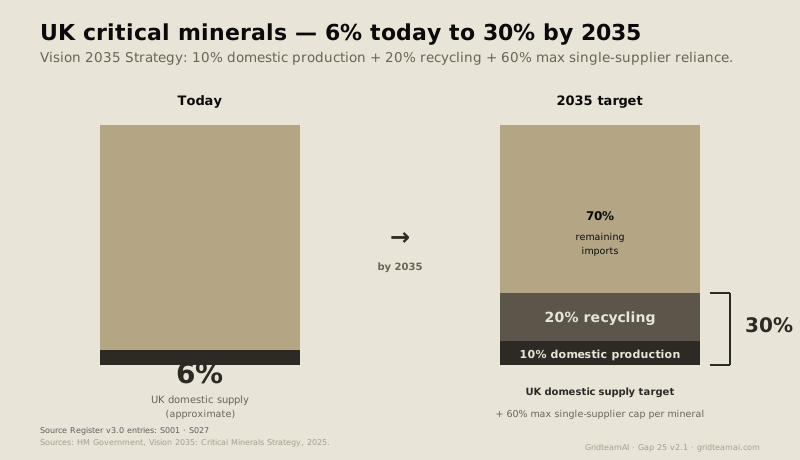
The Strategy targets lifting the UK domestic share of critical-mineral needs from ~6% today to 30% by 2035, split into 10% domestic production plus 20% recycling, with a 60% maximum single-supplier cap per mineral.
Fig. 1 / Section 3
The 30% target (walnut) is bracketed from a 6% base. Recycling (20%) is the larger and more tractable half.
Quarterly Sector Report · Gap 252 · Twelve findings · p. 10
09 — 102 · Six findings · 01 – 04 · 2×2 grid
2 · Twelve findings on critical-minerals exposure10
2 · Twelve findings on critical-minerals exposureQ1 2029
Twelve findings. Each carries a confidence level.
HIGH — verified against a UK Government department, BGS, named TO, Ofgem or recognised think-tank primary source. MEDIUM — named industry or analytics source cross-referenced to a primary source. LOW — GridteamAI scenario projection or interpretation, marked as such.
Findings 01 – 12 · summary
01Vision 2035 reframes UK critical minerals from market matter to security matter.
02The 6%-to-30% transition is the operative quantification — a fivefold expansion.
03Copper demand doubling and lithium rising 12× reframes UK supply diligence.
04The British Geological Survey 2024 assessment is the operative technical baseline.
05Eastern Green Link contracts illustrate the materials concentration risk.
06UK overhead-cables market growth confirms the materials demand trajectory.
07Cornish Lithium and the UK domestic upstream are emerging but small.
08Recycling is the larger half of the 30% target and is operationally maturer.
09International procurement diplomacy is the third leg.
10The Q1 2029 outlook depends on integration of the policy levers.
11Implications for grid operators and project developers.
12Implications for supply-chain businesses, public finance and Government.
Findings 01–06 in detail · pp. 11–13 · 07–12 summarised above
Vision 2035 reframes UK critical minerals from market matter to security matter.
The 2025 refresh of the UK Critical Minerals Strategy — published as Vision 2035 — is a substantial change from the 2022 Resilience for the Future foundational document. The foundational Strategy framed critical minerals as a market and supply-chain matter; the 2025 refresh frames them as a national-security and industrial-strategy matter, with binding numerical targets and reciprocal trade and procurement consequences. Three changes are material: binding numerical targets (30% UK supply, 10% production, 20% recycling, 60% max single-supplier reliance); the expanded 34-mineral list; and an explicit "supply chain stack" — investment, regulation, trade and procurement working in coordination, not market-driven solutions alone. For grid and energy developers, material supply-chain risk is now UK Government policy as well as commercial procurement.
Sources · HM Government Vision 2035 · Chatham House · RUSI
Finding 02 · HIGH
The 6%-to-30% transition is the operative quantification.
The single most operative quantification in the Strategy is the move from approximately 6% UK domestic share of critical-mineral needs today to 30% by 2035 — a fivefold expansion of domestic mining and recycling in roughly ten years. The arithmetic is challenging: UK demand is itself rising sharply, driven by Clean Power 2030, EV manufacturing, electronics and defence, so the 30% share applies to a denominator that is itself increasing. Achieving 30% of an expanded base requires substantially more than 5× growth in domestic supply in absolute terms. The Strategy frames the 10% production + 20% recycling split as the route, with recycling the larger share — reflecting both the maturity of recycling for lithium, cobalt and nickel and the relative ease of scaling recycling versus opening new mines.
Sources · UK Critical Minerals Strategy · GridteamAI analysis
 GridteamAI