£295 single volume · £995/yr annual · Team £2,495 · Enterprise £4,995 · Corporate £9,995. Secure checkout coming soon; email to purchase today.
GridteamAI · Quarterly Sector Report · Gap 24
UK Net Zero Investment Map: The National Wealth Fund, Great British Energy and the Multi-Instrument Finance Architecture — £27.8bn public, the ~3.6:1 mobilisation target
Series consistency · canonical Gap-series system
A4 · 210 × 297 mm · 3 mm bleed (not shown)
UK English · 2026 edition · v1.0
FRONT MATTERi · Cover · ink · full bleed
GridteamAI
Quarterly Sector Report
Volume Gap 24
Cross-sector · Public-Private Capital
by GridteamAI
UK · Public Capital · NWF · Great British EnergyUnited Kingdom · Q3 2028
The Investment Map.
£27.8bn of public capital, a £100bn target — and a reconfigured public-finance stack for UK net zero.
The UK Net Zero Investment Map · Executive summary05
00 · Executive SummaryA two-page brief
£27.8bn of public capital, a £100bn target, two reconfigured institutions.
The National Wealth Fund — successor to the UK Infrastructure Bank — has total announced public capital of £27.8 billion (£22bn carried over from UKIB plus £5.8bn new this parliament), of which about £8.4 billion is deployed. Its January 2026 strategic plan commits to catalyse more than £100 billion of investment — an implied mobilisation ratio of ~3.6:1.
Great British Energy — Royal Assent 16 May 2025, headquartered in Aberdeen — was capitalised with £8.3 billion in the June 2025 Spending Review, of which £2.5 billion is allocated to Great British Energy – Nuclear for SMR development. GBE has launched a £300 million Supply Chain Fund and commits to ≥15 GW by 2030.
The institutional design assigns distinct but complementary roles: NWF as principal policy bank and balance-sheet investor; GBE as developer, supply-chain investor and partnership counterparty. The first major NWF-GBE-SNIB co-investment — a floating offshore wind project — demonstrates the multi-institution model in operation.
GridteamAI · Quarterly Sector Report · Gap 24UK
06Executive summary · continued
The five-body stack interlocks with CfD, LDES and corporate PPAs.
NWF + GBE + SNIB + British Business Bank + UK Export Finance together form the UK public-finance stack for net zero infrastructure. It interlocks with the regulated revenue mechanisms (CfD, Gap 08; LDES Cap-and-Floor, Gap 17) and bilateral commercial revenue (corporate PPAs, Gap 22): the UK has assembled a multi-instrument financial architecture more sophisticated than the one operative in 2020.
The £36.6 billion NWF commitment to Sizewell C is quantified separately under a Regulated Asset Base structure — part of the nuclear public-finance stack, but not part of the principal £100bn mobilisation target.
The volume's argument
The UK has assembled a multi-instrument public-finance architecture for net zero infrastructure that did not exist in 2020. The institutional design is set; the forward outlook is about execution within that architecture — deployment pace, mobilisation-ratio delivery, and political continuity.
The shape of this volume. Section 1 sets out the headline figures. Section 2 develops twelve findings, each confidence-annotated. A chapter-weight pull at p. 14 anchors the argument. Section 3 sets out the two institutions. Section 4 develops the capital and the mobilisation arithmetic. Section 5 isolates the architecture and the forward outlook. Section 6 makes recommendations, with a one-page tear-out at p. 25.
Executive summary · ends1 · The headline figures · p. 07
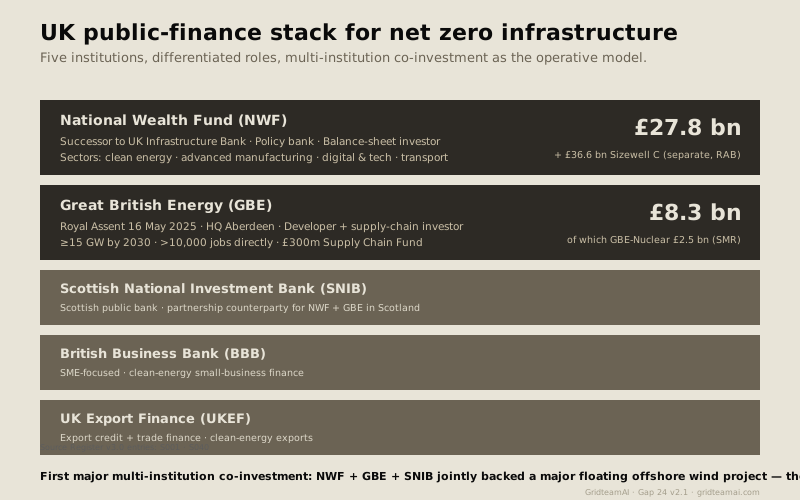
Figure 1 · The UK public-finance stackNWF · GBE · HM Treasury
Five institutions, differentiated roles, multi-institution co-investment.
NWF (£27.8bn) the policy bank and GBE (£8.3bn) the developer lead; SNIB, the British Business Bank and UK Export Finance complete the stack. The first NWF-GBE-SNIB floating offshore wind co-investment shows the model in operation.
Fig. 1 / Section 3
NWF and GBE (walnut) lead; SNIB, BBB and UKEF (neutral) complete the stack. Co-investment is the operative model.
Quarterly Sector Report · Gap 242 · Twelve findings · p. 10
09 — 102 · Six findings · 01 – 04 · 2×2 grid
2 · Twelve findings on the investment map10
2 · Twelve findings on the investment mapQ3 2028
Twelve findings. Each carries a confidence level.
HIGH — verified against an NWF, GBE, HM Treasury, DESNZ, UK Parliament or recognised think-tank primary source. MEDIUM — named industry, legal or analytics source cross-referenced to a primary source. LOW — GridteamAI scenario projection or interpretation, marked as such.
Findings 01 – 12 · summary
01The National Wealth Fund is the operative public balance-sheet investor for net zero.
02The £100 billion mobilisation target is the operative performance metric.
03Great British Energy is a developer, not a financier.
04The £2.5 billion GBE-Nuclear allocation is a strategic SMR signal.
05The GBE Supply Chain Fund addresses a specific constraint.
06The NWF + GBE + SNIB + BBB + UKEF stack is the operative public-finance set.
07The mobilisation challenge is private capital at scale.
08Sizewell C is a distinctive case.
09The interaction with CfD, LDES and corporate PPAs is structurally important.
10Forward outlook depends on deployment pace and pipeline maturity.
11The institutional design has trade-offs and is not closed.
12Implications for developers, investors, supply chain and Government.
Findings 01–06 in detail · pp. 11–13 · 07–12 summarised above
Quarterly Sector Report · Gap 242
112 · Findings 01 – 02
2 · Findings 01 — 02The NWF · the £100bn target
Finding 01 · HIGH
The National Wealth Fund is the operative public balance-sheet investor for net zero.
The National Wealth Fund is the renamed and re-mandated successor to the UK Infrastructure Bank, established at Leeds in 2021. The rebrand and re-mandate — announced in 2024, operationalised through 2025 — repositioned it from a primarily clean-energy investment bank to a broader-remit policy bank covering clean energy, advanced manufacturing, digital and technology, and transport. Total announced public capital is £27.8 billion: £22 billion of legacy UKIB capital (~£3.1bn invested by April 2024) plus £5.8 billion new this parliament. By the January 2026 Strategic Plan it had deployed ~£8.4 billion — close to a third — and committed a further £36.6 billion to Sizewell C separately. The NWF deploys equity, loans, guarantees and local-authority lending with the explicit objective of "crowding in" larger volumes of private investment; it is designed to mobilise private capital at a multi-to-one ratio, not to be the sole financier.
Sources · NWF / HM Treasury · Institute for Government
Finding 02 · HIGH
The £100 billion mobilisation target is the operative performance metric.
The NWF’s January 2026 Strategic Plan committed to catalyse more than £100 billion of investment into UK companies, infrastructure and supply chains over the five-year strategic window. With £27.8 billion of public capital, this implies a headline mobilisation ratio of approximately 3.6:1 — £3.60 of private capital catalysed for every £1.00 of public capital deployed. This is meaningful but not extraordinary: the European Investment Bank and KfW operate broadly comparable policy-bank mobilisation ratios in the 2–4:1 range, so the NWF target sits at the upper end of normal without being aggressive against international benchmarks. The Plan also commits to broader outcome targets — more than 200,000 jobs created or supported, and approximately 500 megatonnes of CO₂-equivalent saved by 2050 — stated as accompanying outcomes of the £100bn target rather than independently quantified deliverables.
Sources · NWF Strategic Plan 2025 · GridteamAI calculation
 GridteamAI