UK Data Centre Planning Reform · Executive summary05
00 · Executive SummaryA two-page brief
Data centres became CNI, the NPPF added grey belt, and the NSIP route arrived — in fifteen months.
On 12 September 2024, Technology Secretary Peter Kyle announced that UK data centres are designated Critical National Infrastructure — the first CNI addition since Space and Defence in 2015, placing data centres alongside water, energy, transport and emergency services.
The December 2024 NPPF revision made two material changes: explicit reference to "the economic need for data centres and digital infrastructure" as a material planning consideration; and the new grey belt designation, allowing development on previously-developed or under-utilised green belt land without the "Very Special Circumstances" test. Hyperscale grey belt approvals have followed.
On 15 October 2025 a Written Ministerial Statement set out the intention to bring data centres into the NSIP regime under section 35 of the Planning Act 2008. The amendment Regulations cleared the Commons and the Lords in November 2025. DSIT is preparing a National Policy Statement for data centres, indicatively published 2026.
GridteamAI · Quarterly Sector Report · Gap 21UK
06Executive summary · continued
UK data centre consenting is now a multi-route process.
Local planning permission for sub-NSIP-threshold projects; the NSIP route for very large projects, with the Secretary of State (advised by the Planning Inspectorate) as decision-maker on a 12–18-month statutory timetable; AI Growth Zone fast-track for designated locations; and section 35 directions for individual projects of national significance. The route now depends on project size and location.
The National Policy Statement for data centres — indicatively published 2026 — will be the operative policy framework against which NSIP decisions are made. It is the most important single planning document for the UK data centre sector this decade.
The volume's argument
UK data centre planning has moved from a discretionary, locally-led process to a strategic, nationally-coordinated one. The role of local planning authorities is not eliminated but it is materially reframed, particularly for the largest projects. The pace of full delivery is uncertain; the direction is not.
The shape of this volume. Section 1 sets out the headline figures. Section 2 develops twelve findings, each confidence-annotated. A chapter-weight pull at p. 14 anchors the argument. Section 3 sets out the three instruments. Section 4 develops the multi-route consenting ladder. Section 5 isolates the NPS and the LPA reframe. Section 6 makes recommendations, with a one-page tear-out at p. 25.
Executive summary · ends1 · The headline figures · p. 07
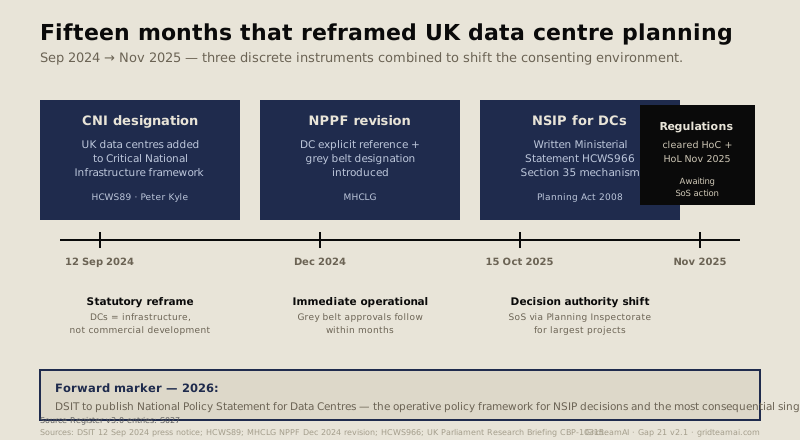
CNI → NPPF grey belt → NSIP → parliamentary clearance.
Four stages from the 12 September 2024 CNI designation through the December 2024 NPPF revision and the 15 October 2025 Written Ministerial Statement to the November 2025 parliamentary clearance — with the 2026 NPS as the forward marker.
Fig. 1 / Section 3
Three reform instruments (indigo) land in fifteen months; parliamentary clearance (ink) awaits final SoS action. The 2026 NPS is the operative framework to come.
Quarterly Sector Report · Gap 212 · Twelve findings · p. 10
09 — 102 · Six findings · 01 – 04 · 2×2 grid
2 · Twelve findings on the planning reform10
2 · Twelve findings on the planning reformQ4 2027
Twelve findings. Each carries a confidence level.
HIGH — verified against a UK Government department, Parliament or regulator primary source. MEDIUM — named industry, planning-law or engineering source cross-referenced to a primary source. LOW — GridteamAI scenario projection or interpretation, marked as such.
Findings 01 – 12 · summary
01The CNI designation reset the UK Government’s posture on data centres.
02The NPPF revision is the most immediately operational change.
03The NSIP route changes the planning authority for the largest projects.
04The National Policy Statement for data centres will be the operative framework.
05AI Growth Zones create a parallel fast-track not yet fully aligned with NSIP.
06The grey belt has had near-immediate operational impact.
07Local planning authorities retain meaningful but reduced control.
08The reform package raises democratic-legitimacy questions at local level.
09EIA, water and biodiversity considerations remain salient.
10The reform package interacts with the wider planning-reform agenda.
11Hyperscale developers are adjusting capital allocation accordingly.
12Implications for developers, hyperscalers, LPAs and advisers.
Findings 01–06 in detail · pp. 11–13 · 07–12 summarised above
The CNI designation reset the UK Government’s posture on data centres.
The 12 September 2024 designation of UK data centres as Critical National Infrastructure was, on the surface, a security and resilience measure: it established a dedicated cross-government data infrastructure team, prioritised National Cyber Security Centre access, and coordinated emergency-services access. The deeper significance was the reframing — data centres placed alongside water, energy, transport, finance and emergency services as sectors whose continuity is a matter of national interest. The signal to Government, local authorities and the planning system was that data centres are no longer a discretionary commercial category; they are infrastructure. This re-categorisation is the precondition for the subsequent NSIP and NPPF moves.
The NPPF revision is the most immediately operational change.
The December 2024 NPPF revision is having the most immediate operational effect. Two paragraphs matter most: the explicit DC reference, requiring planning policies to "pay particular regard to" the economic need for data centres and digital infrastructure — making the economic case a positive planning consideration rather than a neutral one; and the grey belt — previously-developed or under-utilised green belt land that does not strongly contribute to the green belt’s core purposes, where development does not require the "Very Special Circumstances" test. The combined effect gives DC applications two new positive policy hooks; applications since December 2024 have used both, and hyperscale approvals on grey belt land have followed.
Sources · MHCLG NPPF (revised December 2024) · UK Parliament CBP-10315
 GridteamAI