Three boroughs hit the ceiling. 12,000 homes were unlocked. The Iver fix lands in 2027.
In July 2022 the GLA published a notice that three west London boroughs — Hillingdon, Ealing and Hounslow — had reached effective distribution-network capacity limits. New connections were being declined or deferred to as far out as 2035 in worst-case applications.
The GLA attributed the constraint primarily to the concentration of data centre load along the M4 corridor, where fibre-optic backbone density had driven hyperscale clustering. The industry contested the attribution; the GLA’s published position was that data centre demand was the principal incremental driver.
Coordinated work between the GLA, SSEN, NGED, Ofgem and the boroughs connected ~12,000 homes by early 2025 through short-term fixes; 11,690 permitted new homes were unlocked from stalled status, of which 3,315 via SSEN’s ECAS from March 2024. The structural fix is the £75m Iver GSP reinforcement, completing 2027.
GridteamAI · Quarterly Sector Report · Gap 20UK
06Executive summary · continued
The constraint reshaped UK hyperscale site selection — permanently.
Sites that in 2018–2020 would have been the default first choice for hyperscale deployment — the M4 corridor, Slough, west of London — are now subject to extended grid-headroom diligence. Operators increasingly select sites combining fibre proximity with available headroom: the eastern London / Thames / Docklands footprint, and the AI Growth Zone designations (Gap 18). Slough, inside the same SSEN footprint, shares the structural constraint and is particularly exposed.
The London Plan itself is being revisited; a likely outcome is a London-wide requirement for grid-headroom proof at planning-application stage for large-load developments — a permanent shift from treating energy capacity as a permissive matter to treating it as a planning constraint.
The volume's argument
The Iver GSP reinforcement materially releases West London headroom in 2027 — but the precedent, and the headroom-analysis methodology, will shape every subsequent UK hyperscale site decision. Large-load infrastructure must now be designed around grid headroom as a primary input, not a permissive secondary. This is a permanent feature of UK site-selection economics.
The shape of this volume. Section 1 sets out the headline figures. Section 2 develops twelve findings, each confidence-annotated. A chapter-weight pull at p. 14 anchors the argument. Section 3 sets out the constraint and the Iver fix. Section 4 develops the intervention and the housing unlock. Section 5 isolates site selection and the London Plan. Section 6 makes recommendations, with a one-page tear-out at p. 25.
Executive summary · ends1 · The headline figures · p. 07
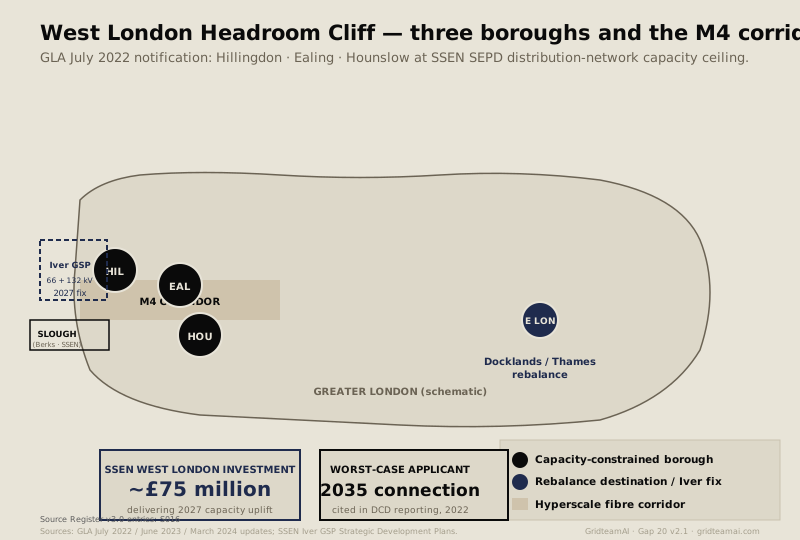
09 · FIG. 11 · West London constraint map · restyled -v2
1 · The headline figures09
Figure 1 · The West London constraintGLA · SSEN · 2022–27
Three boroughs on the M4 corridor, the Iver fix, the eastern rebalance.
Hillingdon, Ealing and Hounslow sit at the SSEN SEPD ceiling; the Iver GSP reinforcement (£75m, 2027) sits to the west; Slough shares the footprint; demand rebalances east toward Docklands and the Thames.
Fig. 1 / Section 3
The constrained boroughs (ink) sit on the M4 corridor; the Iver fix and the eastern rebalance (indigo) are the response. Slough shares the SSEN footprint.
Quarterly Sector Report · Gap 202 · Twelve findings · p. 10
09 — 102 · Six findings · 01 – 04 · 2×2 grid
2 · Twelve findings on the West London cliff10
2 · Twelve findings on the West London cliffQ3 2027
Twelve findings. Each carries a confidence level.
HIGH — verified against a GLA, SSEN, NGED, Ofgem or London borough primary source. MEDIUM — named industry source cross-referenced to a primary source. LOW — GridteamAI scenario projection or interpretation, marked as such.
Findings 01 – 12 · summary
01The West London Headroom Cliff is a documented, dated and quantified constraint.
02Data centres were the principal incremental driver; contested but substantially correct.
03The SSEN-led intervention released material capacity between 2023 and 2025.
04The Iver Grid Supply Point reinforcement is the structural fix; 2027 is the critical year.
05The constraint has reshaped UK hyperscale site selection.
06Planning and grid-headroom proof is becoming a London Plan principle.
07The constraint exposed regulatory and accountability gaps in the DNO planning framework.
08The risk profile has spread across London, though not at the same severity.
09Slough’s exposure is structural and overlapping.
10The industry has responded with on-site generation, demand-flexibility and dual supply.
11The Q3 2027 forward outlook is materially improved but not constraint-free.
12Implications for operators, hyperscalers, local authorities and network operators.
Findings 01–06 in detail · pp. 11–13 · 07–12 summarised above
The West London Headroom Cliff is a documented, dated and quantified constraint.
The GLA’s published documentation provides an unusually clear evidentiary record. The July 2022 background paper set out the position; the June 2023 update revised numbers and added cross-borough coordination detail; the March 2024 update documented progress and cumulative homes-unlocked figures. The constraint applied in its sharpest form to three boroughs — Hillingdon, Ealing, Hounslow — in the SSEN Distribution SEPD footprint, where new applications above modest load were declined or deferred to extreme dates (2035 cited in multiple cases). The structural cause: the 6–10-year lead time of distribution reinforcement, the rapid 2018–2022 growth of M4-corridor data centre load, and the absence of pre-emptive distribution planning frameworks.
Sources · GLA July 2022 / June 2023 / March 2024 updates
Finding 02 · HIGH
Data centres were the principal incremental driver; contested but substantially correct.
The GLA’s published position was that data centre demand was the principal incremental driver. The industry contested the attribution, pointing to housing growth, transport and heat electrification, and the absence of forward capacity planning. The numerical reality: a single hyperscale site at modern density can consume 50–200 MW; by 2022 the cumulative M4-corridor data centre load exceeded that of substantial residential populations, and the data centre share of incremental load growth from ~2015 to 2022 was the largest single line item. We assess the GLA framing substantially correct as a factual matter, while accepting that distribution-planning failure to anticipate the concentration was a parallel cause that should not be elided.
Sources · GLA · Computer Weekly · industry coverage
 GridteamAI