The GB200 rack draws 120 kW. Air cooling stops at 40. The transition is mandatory.
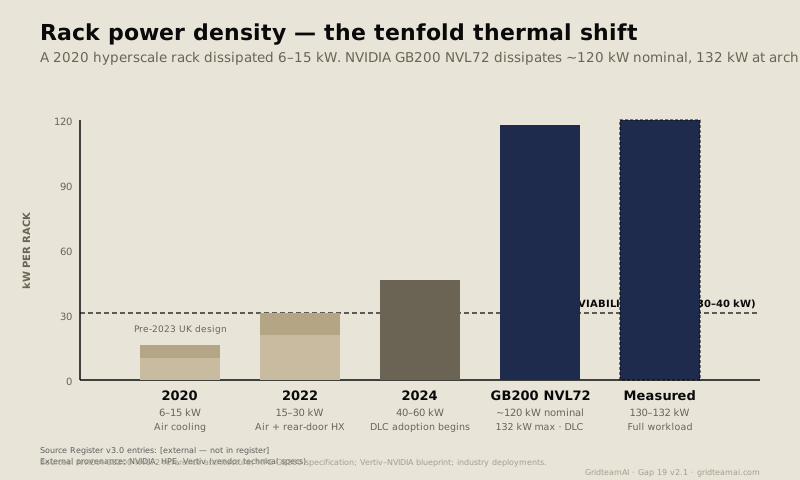
NVIDIA’s GB200 NVL72 — the dominant AI training rack of the 2024–2027 horizon — supports rack densities up to 132 kW, with nominal draw of approximately 120 kW and field-measured loads of 130–132 kW. A 2020-era hyperscale rack dissipated 6–15 kW: an approximately tenfold increase over five years.
Air cooling becomes thermally non-viable above approximately 30–40 kW per rack. Direct liquid cooling — cold-plate direct-to-chip in the dominant variant — is mandatory at GB200 densities. The Uptime Institute’s 2025 survey found 22% of organisations used DLC, 75% perimeter air, 58% of colocation providers offered DLC, and 61% of non-DLC respondents would consider it.
Industry-average PUE has been stable at 1.56–1.59 since 2020; direct-to-chip facilities achieve 1.03–1.20. The UK DC cooling market — USD 681m in 2025 — is forecast to reach USD 2.83bn by 2035 (15.28% CAGR). UK DC electricity demand is projected to rise from ~3.6 TWh (2020) to 22–30 TWh by 2030.
GridteamAI · Quarterly Sector Report · Gap 19UK
06Executive summary · continued
The PUE arithmetic favours liquid cooling materially — at facility and system level.
A 50 MW IT load at industry-average PUE 1.58 consumes 79 MW of grid power; the same load at DLC-optimised PUE 1.10 consumes 55 MW. The 24 MW saving produces a multi-tens-of-millions-of-pounds annual operating-cost differential over a 10-year facility life. At the system level, if 30% of the 6 GW IT-load growth by 2030 is DLC-optimised, the cooling-driven grid-demand reduction is on the order of 700–900 MW.
The capital-cost premium for liquid-ready new build is 10–25% over air-cooled — recoverable on PUE savings within 3–5 years. Retrofit into an existing air-cooled facility runs a 50–100% premium and is frequently not commercially justifiable at facility level.
The volume's argument
A hyperscale data centre committed to AI training in 2026 cannot be designed around air cooling. The strategic deadline for site-level design decisions has effectively already passed for any facility coming on-stream in 2027–2028. The 2027–2030 horizon is about pace, supply chain and execution — not whether the transition happens.
The shape of this volume. Section 1 sets out the headline figures. Section 2 develops twelve findings, each confidence-annotated. A chapter-weight pull at p. 14 anchors the argument. Section 3 sets out the GB200 thermal envelope. Section 4 develops the PUE and financial case. Section 5 isolates grid, water and the retrofit window. Section 6 makes recommendations, with a one-page tear-out at p. 25.
Executive summary · ends1 · The headline figures · p. 07
09 · FIG. 11 · Rack power density progression · restyled -v2
1 · The headline figures09
Figure 1 · Rack power density progressionNVIDIA · HPE · Vertiv
A tenfold thermal shift — from 6–15 kW to 120 kW in five years.
The 30–40 kW air-cooling viability ceiling (dashed) cuts across the progression: every 2024-onward AI rack sits above it, and the GB200 NVL72 sits at roughly three times it.
Fig. 1 / Section 3
The GB200 bars (indigo) clear the air-cooling ceiling threefold. There is no air-cooled middle path above 40 kW.
Quarterly Sector Report · Gap 192 · Twelve findings · p. 10
09 — 102 · Six findings · 01 – 04 · 2×2 grid
2 · Twelve findings on the cooling transition10
2 · Twelve findings on the cooling transitionQ2 2027
Twelve findings. Each carries a confidence level.
HIGH — verified against a manufacturer, regulator, government or industry-standard survey primary source. MEDIUM — named industry source cross-referenced to a primary source. LOW — GridteamAI scenario projection or interpretation, marked as such.
Findings 01 – 12 · summary
01The thermal envelope has fundamentally shifted with the GB200-class platform.
02Air cooling stops being viable; direct liquid cooling becomes mandatory.
03UK DLC adoption is at 22% of organisations but rising rapidly.
04The PUE arithmetic favours liquid cooling materially.
05The UK data centre cooling market is forecast to grow 4× by 2035.
06UK DC electricity demand is projected to rise from ~3.6 to 22–30 TWh by 2030.
07Liquid cooling cuts floor area but raises substation density and water exposure.
08The cooling transition interacts directly with the UK grid-connection bottleneck.
09DSIT AI Growth Zones are implicitly designed around liquid-cooled hyperscale.
10UK retrofit decision-making is on a closing window.
11The transition is technology-mixed; cold-plate dominates, immersion has a footprint.
12Implications for operators, hyperscalers, supply chain and investors.
Findings 01–06 in detail · pp. 11–13 · 07–12 summarised above
The thermal envelope has fundamentally shifted with the GB200-class platform.
NVIDIA’s GB200 NVL72 — a fully-integrated rack-scale AI compute platform containing 72 Blackwell GPUs connected by 5th-generation NVLink — is the reference design for AI training workloads from 2024 onwards. Its nominal rack power is approximately 120 kW; the reference architecture supports up to 132 kW per rack; deployed racks have been measured drawing 130–132 kW under full load. HPE’s specification lists 115 kW liquid-cooled plus 17 kW air-cooled for supporting systems. A typical 2020-era UK colocation rack dissipated 6–15 kW: an approximately tenfold increase over five years. This is not an incremental design improvement; it is a thermal design discontinuity.
Air cooling stops being viable; direct liquid cooling becomes mandatory.
Air cooling — perimeter CRAC/CRAH units, in-row coolers, or rear-door heat exchangers in air-circulation configurations — has a practical viability ceiling of approximately 30–40 kW per rack. Above that, the volumetric airflow required becomes physically impractical: noise rises, hot-aisle hotspots become unmanageable, and fan-power overhead degrades effective PUE. At 120 kW per rack, the only commercially deployed answer is direct liquid cooling, principally cold-plate direct-to-chip: the working fluid is delivered directly to the GPU, CPU and NVSwitch via micro-channel cold plates. The NVIDIA reference architecture specifies a closed rack-level liquid loop; the technology is the deployment standard for the platform, not experimental.
Sources · NVIDIA GB200 NVL72 reference architecture · Vertiv power and cooling blueprint
 GridteamAI