The architecture is built. The 2030 number is now a question of execution.
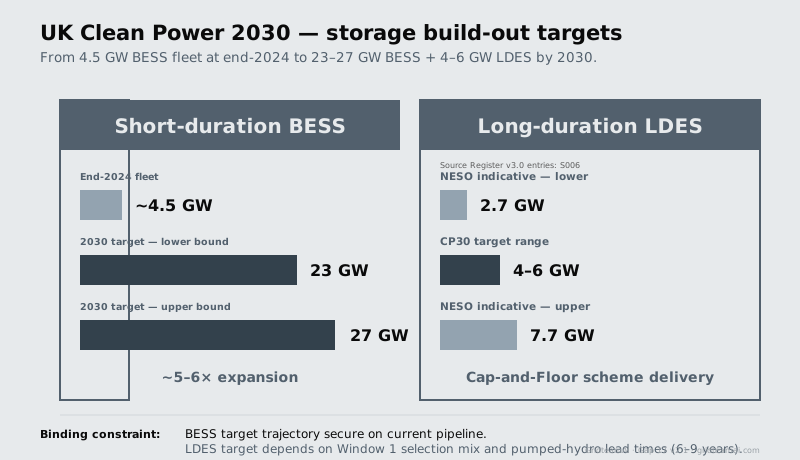
The Clean Power 2030 Action Plan sets indicative 2030 ranges of 23–27 GW for short-duration BESS and 4–6 GW of dispatchable LDES; the GB BESS fleet stood at ~4.5 GW at end-2024, implying a roughly fivefold expansion.
Ofgem opened the first LDES Cap-and-Floor window — the first regulated revenue-floor for storage in ~40 years. Window 1 drew 171 applications; 77 projects (28.7 GW) cleared eligibility on 23 September 2025, ~3.7× the 7.7 GW upper indicative ceiling. The policy question is now selection, not stimulus.
Pumped hydro is back — Coire Glas (1.4 GW), Earba (1.8 GW) and the withdrawn Cruachan II (0.6 GW) — but lead times of 6–9 years cannot be legislated away. Any 2030 LDES capacity must come from projects already consented and at FID by 2026–27.
The question is not whether the BESS target is met, but whether the LDES target is met on time.
Li-ion dominates the eligible cohort by project count; pumped hydro dominates by individual project capacity. Window 1 projects range from 50 MW to nearly 2 GW — Nexus 1 (1.8 GW Li-ion), Earba (1.8 GW PSH) and Coire Glas (1.4 GW PSH) lead the size table. Flow batteries feature in modest numbers; CAES, LAES and gravity did not feature meaningfully.
The Q1 2030 picture
Base case: BESS at 23–25 GW (low-to-mid range); dispatchable LDES at 3–4 GW — below the low end, with PSH lead times the binding constraint. As of October 2026, Coire Glas (1.4 GW), Earba (1.8 GW) and Loch Kemp (660 MW) are among the 16 projects, 7.6 GW in all, that Ofgem provisionally chose in June 2026 for its first cap and floor window, with a decision on a second window expected by 2027. Ofgem had not published final decisions by 21 October 2026. SSE has not yet decided to build Coire Glas.
The shape of this volume. Section 1 sets out the headline figures. Section 2 develops twelve findings, each confidence-annotated. A chapter-weight pull at p. 14 anchors the argument. Section 3 sets out the Clean Power 2030 storage targets. Section 4 maps the return of pumped hydro. Section 5 isolates the LDES Cap-and-Floor regime. Section 6 makes recommendations, with a one-page tear-out at p. 25.
Executive summary · ends1 · The headline figures · p. 07
Figure 1 · The Clean Power 2030 storage targetsDESNZ · NESO · 2024
23–27 GW BESS and 4–6 GW LDES by 2030 — a fivefold expansion.
The GB BESS fleet stood at ~4.5 GW at end-2024; the LDES target sits inside NESO’s 2.7–7.7 GW indicative range, delivered through the Cap-and-Floor scheme.
Fig. 1 / Section 3
The BESS target bars (steel) imply a ~5× expansion; the LDES panel sits inside NESO’s indicative range. BESS is secure on pipeline; LDES is the open question.
Quarterly Sector Report · Gap 172 · Twelve findings · p. 10
09 — 102 · Six findings · 01 – 04 · 2×2 grid
2 · Twelve findings on the UK storage strategy10
2 · Twelve findings on the UK storage strategyQ1 2030
Twelve findings. Each carries a confidence level.
HIGH — verified against a DESNZ, Ofgem, NESO or developer primary source. MEDIUM — named industry coverage cross-referenced to a primary source. LOW — GridteamAI scenario projection, marked as such.
Findings 01 – 12 · summary
01The UK has created a regulated revenue-floor for LDES — first time in forty years.
02Window 1 was substantially over-subscribed; the question is selection, not stimulus.
03Li-ion dominates the eligible cohort by count; pumped hydro by project capacity.
04Pumped hydro is back — but the 6–9 year lead times have not changed.
05Cruachan II’s withdrawal is a warning, not an outlier.
06BESS continues to scale; the 23 GW low-end target is on trajectory.
07The Cap-and-Floor regime is technology-agnostic; the cohort reveals where the market is real.
08Connections Reform is the binding system-side constraint for the BESS half.
09Scottish concentration of LDES creates a regional system-design issue.
10Window 2 will need to address technology-specific cap calibration.
11The 2030 LDES target requires Window 1 to award the upper end of its range.
12Implications for developers, lenders, network operators and corporate buyers.
Findings 01 – 09 follow in detail · pp. 10 – 14 · 10 – 12 summarised on the matrix
The UK has created a regulated revenue-floor for long-duration storage — first time in forty years.
The LDES Cap-and-Floor scheme, designed by DESNZ and operated by Ofgem, is the UK’s first regulated revenue mechanism targeted at storage with eight-hour-plus discharge. Modelled on the interconnector regime, it guarantees a minimum revenue (floor) and returns merchant revenue above a cap to consumers. This is the most material structural change to UK storage policy since the pumped-hydro build-out of the early 1980s: market-led BESS revenue is short-duration by design and cannot finance assets with 60–100-year lives and £1–2 bn capital costs. Cap-and-Floor is the financing answer.
Finding 02 · HIGH
Window 1 was substantially over-subscribed; the policy question is now selection, not stimulus.
Ofgem received 171 applications in Window 1 (closed 9 June 2025); on 23 September 2025, 77 projects totalling 28.7 GW cleared eligibility — roughly 3.7× the 7.7 GW upper end of NESO’s indicative range. A substantial majority of eligible projects will not receive support in this window; Ofgem’s Project Assessment criteria (value-for-money, deliverability, system need, technology fit) become the operative filters. The scheme has done its market-formation job — the question is no longer whether developers respond to a revenue floor, but which projects, and at what cost to consumers, are supported.
Finding 03 · HIGH
Lithium-ion dominates the eligible cohort by count; pumped hydro dominates by project capacity.
Across the 77 eligible projects, Li-ion is most-represented by count — reflecting supply-chain maturity, lower per-MW capital cost and shorter build. But by individual capacity, pumped hydro leads: Earba (1.8 GW) and Coire Glas (1.4 GW) top the size table alongside the largest Li-ion entrant, Nexus 1 (1.8 GW). Flow batteries feature at smaller scale. A few mega-PSH awards would consume much of the indicative ceiling one project at a time; many mid-scale Li-ion awards would reach a similar total via distinct projects. Ofgem’s assessment must balance technology diversification, system need and capital efficiency.
 GridteamAI