← GridteamAI

Purchase access

This is part of the paid GridteamAI Quarterly Sector Report.

Purchase access — book@gridteamai.com

£295 single volume · £995/yr annual · Team £2,495 · Enterprise £4,995 · Corporate £9,995. Secure checkout coming soon; email to purchase today.

GridteamAI · Quarterly Sector Report · Gap 16
Welsh Marine Plan + Crown Estate Wales — a devolution decision awaiting its moment, decoded
Series consistency · canonical Gap-series system
A4 · 210 × 297 mm · 3 mm bleed (not shown)
UK English · 2026 edition · v1.0
FRONT MATTERi · Cover · ink · full bleed
GridteamAI
Quarterly Sector Report
Volume Gap 16
Renewables Generation
by GridteamAI
Wales · Marine Spatial Planning · Crown Estate · Round 5 United Kingdom · Q4 2029

Welsh Marine Plan
+ Crown Estate.

A devolution decision awaiting its moment — and 4.5 GW of Celtic Sea floating wind committed regardless.

gridteamai.com · book@gridteamai.com v2.1 · Q4 2029 Consultancy-grade deliverable
05 — 06Executive summary · spread
Welsh Marine Plan + Crown Estate Wales · Executive summary05
00 · Executive Summary A two-page brief

A constitutional question, a closing financial window, and 4.5 GW committed regardless.

The Crown Estate manages ~65% of the Welsh foreshore, >50,000 acres of land and most of the seabed to 12 nautical miles. Scotland’s estate devolved in 2017; Wales sits asymmetric — marine planning and licensing devolved, the seabed property right reserved.

The Crown Estate (Wales) Bill passed its Lords report stage on 22 July 2025; all 22 Welsh councils back devolution; a Welsh Government expert group reported interim findings in March 2026. The UK Government has not indicated support.

Round 5 awarded 4.5 GW of Celtic Sea floating wind (3 × 1.5 GW) to Equinor, Gwynt Glas and Ocean Winds. The Crown Estate’s £1.1 bn 2024/25 profit steps down to ~£25 m/year option fees from January 2026 — Wales has largely missed the windfall window.

The Q4 2029 picture

Round 5 is in build-out across all three Project Development Areas; the Welsh National Marine Plan has been refreshed at least once; NRW marine-licensing capacity is materially expanded. Operational devolution remains plausible but unconfirmed.

The shape of this volume. Section 1 sets out the headline figures. Section 2 develops twelve findings, each confidence-annotated. A chapter-weight pull at p. 14 anchors the argument. Section 3 sets out the institutional architecture — Crown Estate, Marine Plan, NRW, Senedd. Section 4 covers Round 5 and the Celtic Sea. Section 5 covers the financial and devolution case. Section 6 makes recommendations, with a one-page tear-out at p. 25.

Executive summary · ends1 · The headline figures · p. 07
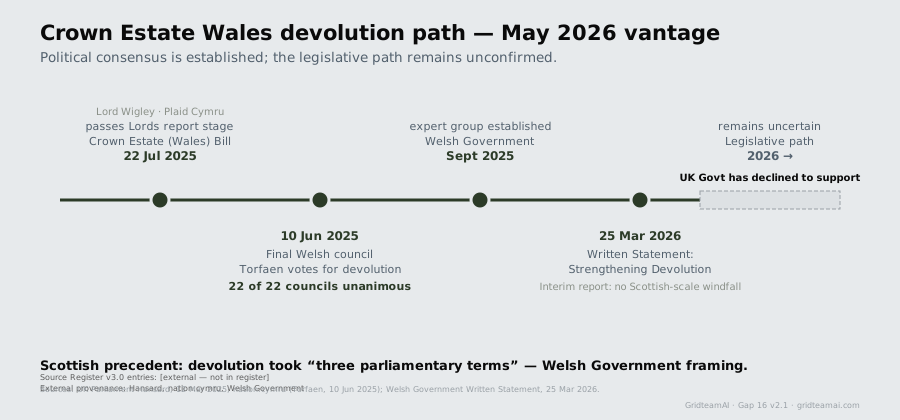
09 · FIG. 11 · Devolution path timeline · restyled -v2
1 · The headline figures09
Figure 1 · The devolution pathUK Parliament · Welsh Govt · 2025–26

Political consensus established; the legislative path unconfirmed.

Four verified milestones: Torfaen completes the 22-of-22 council consensus (10 Jun 2025); the Bill clears Lords report stage (22 Jul 2025); the expert group is established (Sept 2025); and the Written Statement lands (25 Mar 2026). The UK Government has declined to support the Bill.

Crown Estate Wales devolution path from a May 2026 vantage, shown as a horizontal timeline with four verified milestones: 10 June 2025, Torfaen becomes the final of 22 Welsh councils to back devolution (unanimous); 22 July 2025, the Crown Estate (Wales) Bill passes its House of Lords report stage (Lord Wigley, Plaid Cymru); September 2025, the Welsh Government expert group is established; and 25 March 2026, the Written Statement on Strengthening Devolution, whose interim report acknowledges no Scottish-scale windfall. A future zone from 2026 onward marks the unconfirmed legislative path, noting the UK Government has declined to support the Bill, with the Scottish precedent of three parliamentary terms.
Fig. 1 / Section 1

Four moss milestones mark the established political consensus; the dashed zone is the unconfirmed legislative path. The UK Government has declined to support the Bill.

Quarterly Sector Report · Gap 162 · Twelve findings · p. 10
09 — 102 · Twelve findings · 01 – 03
2 · Twelve findings on the Welsh marine estate10
2 · Twelve findings on the Welsh marine estateQ4 2029

Twelve findings. Each carries a confidence level.

HIGH — verified against a UK Government, Welsh Government, UK Parliament or Crown Estate primary source. MEDIUM — named industry source cross-referenced to a primary source. LOW — GridteamAI scenario projection, marked as such.

Findings 01 – 12 · summary

  1. 01The Welsh Crown Estate is large, valuable in principle, and constitutionally distinct.
  2. 02The Crown Estate (Wales) Bill is the most advanced vehicle but lacks UK Government support.
  3. 03Welsh political consensus on devolution is broad and unanimous at local-authority level (22/22).
  4. 04The financial case is now structurally weaker than it would have been pre-2022.
  5. 05Round 5 has committed 4.5 GW of Celtic Sea floating wind — three 1.5 GW bidders.
  6. 06The Welsh National Marine Plan provides the spatial framework but not the property right.
  7. 07The fiscal and constitutional architecture for a devolved estate is not yet defined.
  8. 08Round 5 creates supply-chain and port-capacity exposure that is partly Welsh.
  9. 09The Crown Estate’s energy-transition role has compressed the case for reform or devolution.
  10. 10The Senedd has limited but increasing convening power on marine policy.
  11. 11The outlook depends on whether Round 6 happens before or after a devolution decision.
  12. 12Implications for developers, ports, supply chain and Welsh public bodies.

Findings 01 – 09 follow in detail · pp. 10 – 12 · 10 – 12 summarised on the matrix

Quarterly Sector Report · Gap 162
112 · Findings 01 – 03
2 · Findings 01 — 03The estate · the Bill · the consensus
Finding 01 · HIGH

The Welsh Crown Estate is large, valuable in principle, and constitutionally distinct.

The Crown Estate manages seabed to 12 nautical miles, foreshore and significant land, with net revenue surrendered to the Treasury. In Wales it holds ~65% of the foreshore, >50,000 acres of land and most of the seabed within Welsh territorial waters. Scotland’s estate devolved by the Scotland Act 2016 (operational transfer April 2017); Wales sits asymmetric — marine and onshore planning devolved, marine licensing via NRW, but the underlying seabed property right reserved. This asymmetry is the structural fact every other Finding turns on.

Finding 02 · HIGH

The Crown Estate (Wales) Bill is the most advanced vehicle but lacks UK Government support.

The Bill, introduced by Lord Wigley, passed its Lords report stage unopposed on 22 July 2025, seeking to devolve management of the Welsh Crown Estate on a model broadly comparable to Scotland. The UK Government has not indicated it will support it; without Government time a private members bill is unlikely to clear the Commons, so the immediate effect is political rather than legal — a parliamentary marker. The Welsh Government’s position is that devolution is “a process, not an event,” citing the three-parliamentary-term Scottish timeframe.

Finding 03 · HIGH

Welsh political consensus on devolution is broad and unanimous at local-authority level.

All 22 Welsh principal authorities have passed motions calling for devolution; the last, Torfaen, voted on 10 June 2025 — a cross-party unanimity (Labour, Plaid Cymru, Conservative, independent) with no recent UK constitutional precedent. It matters operationally: it removes the “Welsh opinion is divided” objection, and signals to bidders that a future devolved estate would not begin in a contested institutional environment, lowering policy-reversal risk under successor administrations.

2 · 01 – 03Findings 04 – 06 · facing