Six observations summarise the twelve findings that follow.
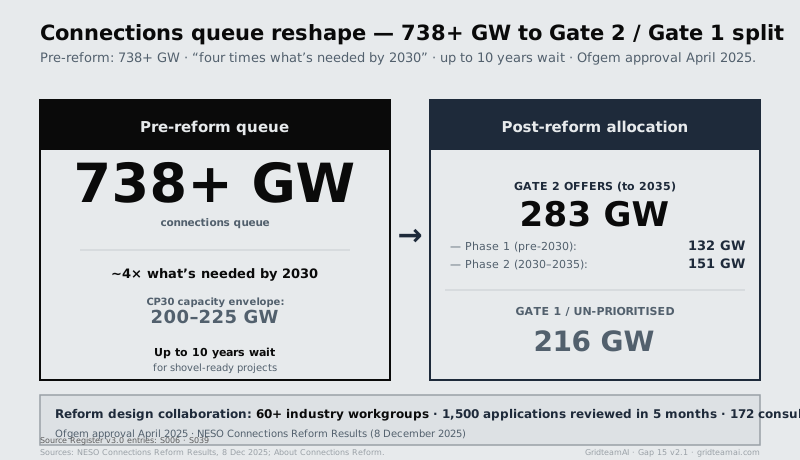
The pre-reform queue — over 738 GW, four times what Great Britain needs by 2030, with shovel-ready projects waiting up to 10 years — has been reordered into a delivery pipeline. Stage 1 is complete: 283 GW of Gate 2 offers against 216 GW left at Gate 1 or un-prioritised.
Six observations stand out: the old queue has been reordered; Gate 1 vs Gate 2 is now the operational distinction (only Gate 2 is bankable); the offer-window timeline is in flight (protected → Phase 1 → Phase 2, Scotland first); the zonal framework is operational (8 DNO + 11 TO zones); the technology pipeline is actively managed (the 55 GW battery trigger); and the Year-3 review will assess delivery, not reordering.
The consequence: the reform has done the necessary thing (reordered the queue) but not the sufficient thing (delivered the pipeline). The Q3 2029 Year-3 review will document delivery — FID rate, build-out rate, and how the offer machinery scaled under Phase 1 + Phase 2 load.
Stage 1 is complete; Stage 2 — delivery — is the structural test.
Ofgem approved the reform in April 2025; NESO ran the Gate 2 to Whole Queue (G2TWQ) assessment across 60+ industry workgroups, 1,500 applications in 5 months and 172 consultation responses. The protected tranche issues first (Feb–May 2026); Gate 2 Phase 1 offers run mid-May to mid-November 2026; Phase 2 to mid-March 2027. Scotland issues offers first.
For the wider Clean Power 2030 programme, the interlock is structural
The reform is the connections-side of an integrated architecture: it interlocks with RIIO-ED3 (Gap 05) for DNO capex, the Eastern Green Link + ASTI transmission backbone (Gap 11), and the CfD allocation cycles. A Gate 2 offer that has not been built by Q3 2029 may be a connections problem, a transmission-delivery problem, or a DNO capex problem — diagnosing which is the Year-3 review skill.
The shape of this volume. Section 1 sets out the headline figures. Section 2 develops twelve findings, each confidence-annotated. A chapter-weight pull at p. 14 anchors the argument. Section 3 decodes the four-element reform architecture. Section 4 sets out the offer-window timeline and the old-vs-new queue. Section 5 decodes the zonal framework and strategic-demand prioritisation. Section 6 sets out recommendations, with a one-page tear-out at p. 25.
Executive summary · ends1 · The headline figures · p. 07
The pre-reform queue — ~4× the 200–225 GW Clean Power 2030 need, with up to 10-year waits — reordered into 283 GW of Gate 2 offers (132 Phase 1 + 151 Phase 2) and 216 GW left at Gate 1; designed across 60+ workgroups, 1,500 applications and 172 responses.
Fig. 1 / Section 1
The pre-reform queue (ink) is the problem state; the navy panel is the reordered pipeline. Only the 283 GW Gate 2 sub-total is bankable.
Quarterly Sector Report · Gap 152 · Twelve findings · p. 10
09 — 102 · Six findings · 01 – 04 · 2×2 grid
2 · Twelve findings on the reformed regime10
2 · Twelve findings on the reformed regimeQ3 2029 · forward-looking
Twelve findings. Each carries a confidence level.
HIGH — anchored to a verified NESO published position. MEDIUM — NESO/Ofgem direction of travel with material implementation questions open. LOW — GridteamAI inference where the source supports direction but not magnitude or pacing.
Findings 01 – 12 · summary
01Stage 1 of the reform — the reordering — is complete.
02The Gate 1 / Gate 2 distinction is the single most important distinction in the regime.
03The reform is operating on a published timeline, with full transparency around revision.
04Scotland is sequenced first; locational sequencing is now a structural feature.
05The protected tranche is in flight and is a leading indicator of the Year-3 review.
06The Gate 2 Phase 1 window is the structural test of NESO and TO/DNO operational capacity.
07The zonal framework operationalises Strategic-alignment by region and technology.
08The technology mix in the pipeline diverges materially from a generic queue snapshot.
09Strategic alignment is the second criterion alongside readiness.
10The reform interlocks with RIIO-ED3, transmission build-out and Strategic Energy Planning.
11The reform has placed customer-support quality at the centre of operational delivery.
12The Q3 2029 Year-3 review will assess delivery, not reordering.
Findings 01 – 09 follow in detail · pp. 10 – 12 · 10 – 12 carried on the Section 6 matrix
Quarterly Sector Report · Gap 152
112 · Findings 01 – 03
2 · Findings 01 — 03Reordering done · Gate 1 vs Gate 2 · the timeline
Finding 01 · HIGH
Stage 1 of the reform — the reordering — is complete.
The pre-reform queue of over 738 GW has been worked through into a delivery pipeline aligned to the 200–225 GW Clean Power 2030 envelope, across 60+ industry workgroups, 1,500 applications reviewed in 5 months and 172 consultation responses; Ofgem approved the reform in April 2025. The structural consequence is that the pipeline now exists. The question from May 2026 onwards is no longer “can the queue be reordered” but “can the reordered pipeline be delivered at the pace required.”
Finding 02 · HIGH
The Gate 1 / Gate 2 distinction is the single most important distinction in the regime.
The bifurcation between contracted offers (Gate 2 — confirmed connection date, point and queue position) and indicative routes (Gate 1 — none of these) is the structural innovation. The same headline GW figure may include both categories, but the commercial value differs in kind, not degree. For any external analysis of UK pipeline data the implication is direct: the headline GW total mixes the two and is not the right datum — the Gate 2 sub-total is the right datum for any commercial decision.
Finding 03 · HIGH
The reform is operating on a published timeline, with transparency around revision.
On 13 February 2026 NESO, the TOs, DNOs and delivery partners jointly confirmed a revised delivery timeline — citing locations where Gate 2 volume exceeded forecast and offers needing more time to ensure accurate construction-planning assumptions — set out openly, with a 17 April 2026 clarification at customer request and a commitment to regular dashboard reporting. The structural inference is high regulatory awareness and customer-engagement discipline: an “explain what is delivering and when, including where it slips” framing.
 GridteamAI