The legislative basis is set; delivery pace is the open question.
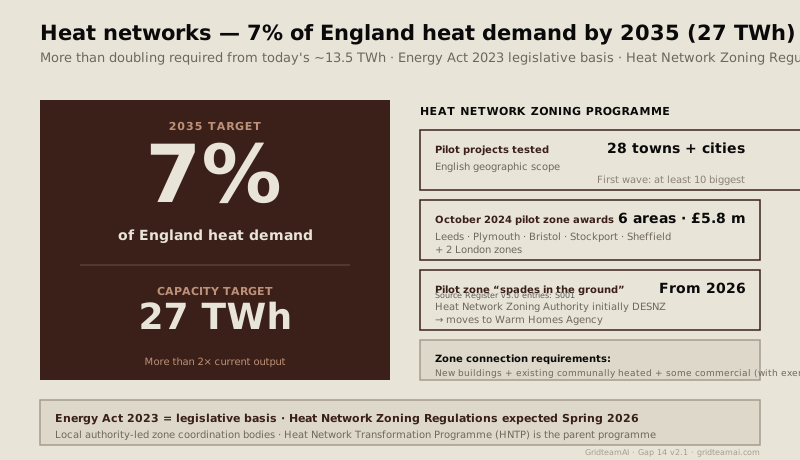
The Energy Act 2023 created the basis for Heat Network Zoning; the Zoning Regulations are expected Spring 2026. The 2035 target is 7% of England heat demand — 27 TWh, more than doubling current output. Six pilot zones were funded £5.8m in October 2024.
The Green Heat Network Fund — within the Heat Network Transformation Programme — has awarded £621m to 63 projects (from a £288m 2022 base) and is extended to 2029/30 at £195m/year, alongside HNES at £15m/year. The £13.2 bn Warm Homes Plan anchors the framework.
28 English towns and cities have been tested; at least 10 of the biggest will be supported soon after the Regulations go live. Local authorities are at the centre of delivery through zone coordination bodies — and the Zoning Authority moves from DESNZ to the forthcoming Warm Homes Agency.
The question is whether build-out converts zoning powers into operational networks at scale.
The UK heat-networks capital programme has run from HNIP (£165m+, 2018–2022) through the GHNF (£621m to 63 projects from a £288m base) to a £195m/year extension to 2029/30 — cumulatively approaching £1.5–2.0 bn by 2029/30, within the £13.2 bn Warm Homes Plan. Mandatory connection in designated zones is the structural commercial precondition.
The Q2 2029 picture
Zoning Regulations in force ~3 years; 10+ first-wave zones designated and in active build-out; the six October 2024 pilot zones at varying stages of operation; second-wave zones being designated; GHNF £195m/year operational; local-authority delivery capacity materially expanded.
The shape of this volume. Section 1 sets out the headline figures. Section 2 develops twelve findings, each confidence-annotated. A chapter-weight pull at p. 14 anchors the argument. Section 3 sets out the heat networks architecture. Section 4 details the six pilot zones and GHNF funding. Section 5 covers the Zoning Regulations and local-authority delivery. Section 6 makes recommendations, with a one-page tear-out at p. 25.
Executive summary · ends1 · The headline figures · p. 07
09 · FIG. 11 · 7% by 2035 target · restyled -v2
1 · The headline figures09
Figure 1 · The 2035 targetDESNZ · Energy Act 2023 · 2024–26
7% of England heat by 2035 — 27 TWh, more than doubling output.
The Energy Act 2023 is the legislative basis; the Zoning Regulations are expected Spring 2026; 28 towns tested, six pilot zones funded £5.8m in October 2024, with at least 10 of the biggest supported soon after the Regulations go live.
Fig. 1 / Section 1
The 27 TWh target (umber) more than doubles current output; the zoning programme panel carries the delivery mechanism. Connection requirements are the commercial precondition.
Quarterly Sector Report · Gap 142 · Twelve findings · p. 10
09 — 102 · Six findings · 01 – 04 · 2×2 grid
2 · Twelve findings on UK heat networks10
2 · Twelve findings on UK heat networksQ2 2029
Twelve findings. Each carries a confidence level.
HIGH — anchored to a verified DESNZ position. MEDIUM — named industry coverage with credible methodology. LOW — GridteamAI projection where the source supports direction but not magnitude.
Findings 01 – 12 · summary
01The Energy Act 2023 created the structural basis for Heat Network Zoning.
02The 2035 target is 27 TWh — 7% of England heat, more than doubling output.
0328 English towns and cities have been tested as pilot projects.
04Six pilot zones were funded with £5.8 million in October 2024.
05At least 10 of the biggest towns and cities will be supported soon after the Regulations.
06The Green Heat Network Fund has structural capital availability to 2029/30.
07HNIP delivered £165m+ funding since 2018 — the operational precedent.
08The Warm Homes Plan anchors heat networks within a £13.2 billion framework.
09Local authorities are at the centre of delivery.
10Connection requirements in designated zones are structurally significant.
11Heat-network decarbonisation pathways are structurally diverse.
12The Q2 2029 picture: operational scale and second-wave designation.
Findings 01 – 09 follow in detail · pp. 10 – 12 · 10 – 12 summarised on the matrix
Quarterly Sector Report · Gap 142
112 · Findings 01 – 03
2 · Findings 01 — 03The Energy Act · the 2035 target · the pilots
Finding 01 · HIGH
The Energy Act 2023 created the structural basis for Heat Network Zoning.
Per DESNZ and legislation.gov.uk, the Energy Act 2023 provides the powers to implement heat network zoning in England through regulations, expected to be laid in Parliament in Spring 2026. Pre-Act, UK heat-network development was primarily commercial — voluntary connection and project-by-project economics. Designated zones permit mandatory connection requirements for specified building categories, materially changing the commercial economics for operators. For Q2 2029, the Regulations are projected in force ~3 years, with first-wave zones designated and mandatory connection operational.
Finding 02 · HIGH
The 2035 target is 27 TWh — more than doubling current output.
Per UK Government, 7% of England heat demand is to be met by heat networks by 2035, equivalent to 27 TWh — more than doubling current output and implying substantial new capacity build-out. Achieving it requires sustained deployment through 2026–2035: the Zoning Regulations provide connection certainty, GHNF £195m/year provides capital, the £13.2bn Warm Homes Plan anchors, and local-authority delivery executes. For Q2 2029, cumulative output is projected materially expanded, with first-wave designated zones contributing additional capacity.
Finding 03 · HIGH
28 English towns and cities have been tested as pilot projects.
Per DESNZ, the zoning model has been tested and refined with pilot projects in 28 English towns and cities, developing the methodology, refining designation criteria and preparing local authorities for the post-Regulations framework. Six of the 28 were awarded £5.8m in October 2024; the remaining 22 are dispersed across DESNZ disclosures. For Q2 2029, the pilot areas are projected substantively converted into designated zones, with pilot learnings incorporated into the Regulations design.
 GridteamAI