The Hydrogen Allocation Round · Executive summary05
00 · Executive SummaryA two-page brief
The framework gives certainty; the pace may not hit the 2030 ambition.
The UK target is 10 GW of low-carbon hydrogen production by 2030 — at least 5 GW electrolytic (6 GW in the updated split). HAR1 awarded 11 projects / 125 MW (December 2023), below the 250 MW round target, with over £2 bn of 15-year revenue support via the HPBM.
HAR2 shortlisted 27 projects / 765 MW (announced 7 April 2025), with final awards due early 2026 and an explicit cost-challenge framework. HAR1 strike prices averaged £241/MWh — roughly 2.6× the AR7 offshore-wind clearing price.
HAR3 launches through 2026 and HAR4 in 2028 (combined up to 1.5 GW). At May 2026, cumulative HAR activity (~1 GW) is ~17% of the 6 GW electrolytic 2030 target — materially more allocation and FIDs are required to close the gap.
The question is whether the cumulative HAR trajectory is on credible path to 2030.
HAR1 revenue support runs to over £2 billion across 15 years (HPBM / LCHA contracts) plus £90m capital grants via the Net Zero Hydrogen Fund. By July 2025, 9 of 11 HAR1 contracts were signed; January and March 2025 signings cleared at £6.3–£7.1/kg. Industrial off-taker anchoring — refineries, chemicals, SAF — is structurally favoured.
The Q1 2029 picture
HAR1 first projects approaching commissioning; HAR2 final awards (early 2026) in active development; HAR3 outcomes announced (~early 2027); HAR4 just launched. Cumulative HAR allocation 1.4–1.8 GW — roughly 25–30% of the 6 GW electrolytic target, with 12–18 months to 2030.
The shape of this volume. Section 1 sets out the headline figures. Section 2 develops twelve findings, each confidence-annotated. A chapter-weight pull at p. 14 anchors the argument. Section 3 sets out the UK hydrogen architecture. Section 4 details HAR1 and the HAR2 shortlist. Section 5 covers the HAR3/HAR4 trajectory and the IRA 45V comparison. Section 6 makes recommendations, with a one-page tear-out at p. 25.
Executive summary · ends1 · The headline figures · p. 07
09 · FIG. 11 · HAR1 anatomy · restyled -v2
1 · The headline figures09
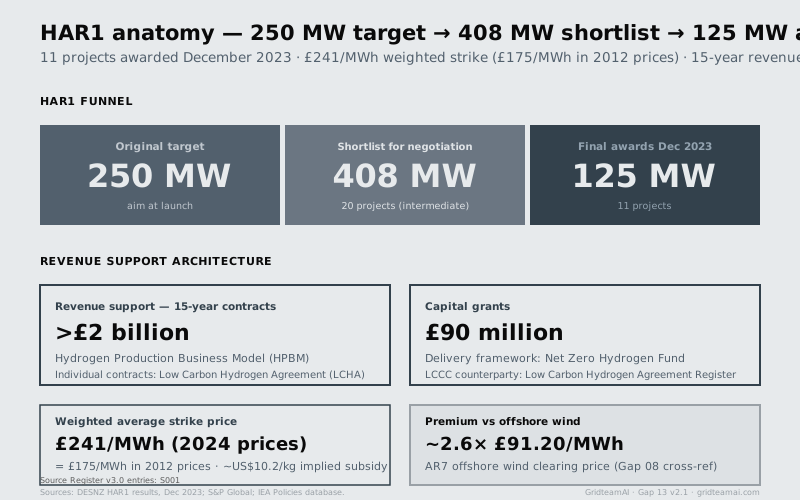
Figure 1 · The HAR1 anatomyDESNZ · S&P Global · 2023–25
Over £2 bn of 15-year revenue support via the HPBM plus £90m capital grants; a £241/MWh weighted strike (£175/MWh in 2012 prices) — about 2.6× the offshore-wind clearing price.
Fig. 1 / Section 1
The awarded 125 MW (steel) is half the round target; the funnel shows the attrition from 250 MW. The premium comparator is shown on the neutral panel.
Quarterly Sector Report · Gap 132 · Twelve findings · p. 10
09 — 102 · Six findings · 01 – 04 · 2×2 grid
2 · Twelve findings on the UK HAR framework10
2 · Twelve findings on the UK HAR frameworkQ1 2029
Twelve findings. Each carries a confidence level.
HIGH — anchored to a verified DESNZ position. MEDIUM — named industry coverage with credible methodology. LOW — GridteamAI projection where the source supports direction but not magnitude.
Findings 01 – 12 · summary
01The UK target is 10 GW low-carbon hydrogen production by 2030 — at least 5 GW electrolytic.
02HAR1 awarded 11 projects totalling 125 MW — below the original 250 MW target.
03HAR2 shortlisted 27 projects totalling 765 MW — final awards due early 2026.
04The HAR2 cost-challenge framework is structurally significant.
05HAR1 strike prices reveal a structural cost gap vs offshore wind (~2.6×).
06HAR3 launches 2026 and HAR4 in 2028 — combined 1.5 GW ambition.
07Industrial off-taker anchoring is structurally favoured in HAR.
08Grid connection is the binding constraint on electrolytic projects.
09The IRA 45V framework competes directly with UK HAR for capital.
10The Low Carbon Hydrogen Standard updates are operational variables.
11HAR interlocks with the wider clean-power and industrial-decarbonisation architecture.
12The Q1 2029 picture: delivery, HAR3 outcomes, and the 2030 trajectory.
Findings 01 – 09 follow in detail · pp. 10 – 12 · 10 – 12 summarised on the matrix
The UK target is 10 GW low-carbon hydrogen production by 2030 — ≥5 GW electrolytic.
Per the UK Hydrogen Strategy: up to 10 GW of low-carbon hydrogen production capacity by 2030, with at least half electrolytic (5 GW); the updated split is 4 GW CCUS-supported + 6 GW electrolytic. The target is an ambitious ramp from near-zero operational electrolytic capacity. At May 2026, HAR1 + HAR2 cumulative (~1 GW) is approximately 17% of the 6 GW electrolytic target; by Q1 2029, with HAR3 + partial HAR4, cumulative allocation could reach ~2.5 GW (~42%) with 12–18 months to 2030.
Finding 02 · HIGH
HAR1 awarded 11 projects totalling 125 MW — below the original 250 MW target.
Per the December 2023 HAR1 results, 11 projects were awarded totalling 125 MW — about half the 250 MW round target (an intermediate stage shortlisted 20 projects / 408 MW for negotiation). Financial commitments: over £2 bn revenue support across 15 years (HPBM / LCHA), £90m capital grants (Net Zero Hydrogen Fund), £241/MWh average strike. By July 2025, 9 of 11 contracts were signed. Underdelivery against the HAR1 target frames the pace concern for later rounds.
Finding 03 · HIGH
HAR2 shortlisted 27 projects totalling 765 MW — final awards due early 2026.
Per the 7 April 2025 DESNZ announcement by Industry Minister Sarah Jones, 27 green hydrogen projects were shortlisted across England, Scotland and Wales, covering ammonia, power generation, glass, brick making and SAF. Total shortlisted capacity is reported as 765 MW (Driving Hydrogen / Energy Voice / Osborne Clarke) or 875 MW (H2-View) — to be re-verified against the gov.uk publication. Shortlisted developers include Carlton Power, Lhyfe, RWE and Scottish Power; final awards are due early 2026.
 GridteamAI