Demand-Side Response in 2029 · Executive summary05
00 · Executive SummaryA two-page brief
DSR is now structurally embedded in UK power-system operation.
DSR is structurally embedded: the RIIO-ED3 Build-and-Flex obligation (Gap 05), the Elexon Market Facilitator role from December 2025, the DFS bi-directional + zonal + 0.1 MW threshold from 9 April 2026, and the ENA Open Networks products together create a coherent UK DSR operational architecture.
NESO’s DFS has scaled to 2.46m participants (March 2026), delivering ~800 MWh across events with companies earning up to £8,000. The Clean Flexibility Roadmap sets 55.2 GW total flexibility by 2030 (204 GW by 2050); the NESO consumer-led target is 12 GW by 2030.
The Clean Heat Market Mechanism (SI 2025/81) creates controllable residential load; V2G has moved past the pilot threshold; Ofgem BSC P483 unlocked ~345,000 households; and MHHS completes by May 2027 — the structural enabler of full residential participation.
GridteamAI · Quarterly Sector Report · Gap 12UK
06Executive summary · continued
DSR is no longer “next year’s story.” It is a structural counter to BESS, and the demand side of the UK flexibility market.
DSR operates across four segments — industrial (the volume leader), commercial, residential and EV-fleet — under a coordinated NESO + Elexon + DNO architecture. Aggregators orchestrate multi-asset household nodes (smart meter + V2G EV + heat pump) and multi-site industrial portfolios across the revenue stack.
The Q4 2028 picture
DFS participation projected at 4–6 million; the 12 GW consumer-led 2030 target 60–80% delivered; contracted UK flexibility in the 15–20 GW range with Build-and-Flex operational; V2G mass-market from multiple suppliers; CHMM Year 4 (2028/29) approaching final year; MHHS complete since May 2027.
The shape of this volume. Section 1 sets out the headline figures. Section 2 develops twelve findings, each confidence-annotated. A chapter-weight pull at p. 14 anchors the argument. Section 3 sets out the five-element DSR architecture. Section 4 covers industrial and residential DSR plus V2G. Section 5 covers heat-pump load control and the aggregator revenue stack. Section 6 makes recommendations, with a one-page tear-out at p. 25.
Executive summary · ends1 · The headline figures · p. 07
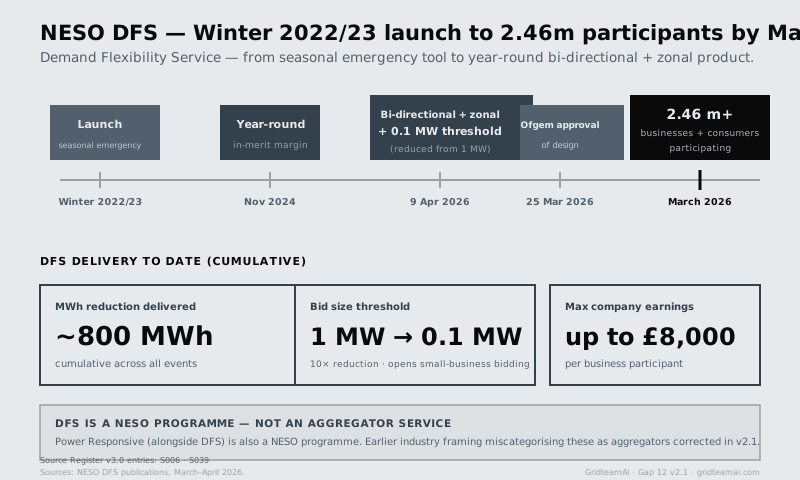
From a Winter 2022/23 emergency tool to 2.46m participants by March 2026.
Year-round in-merit from November 2024; bi-directional + zonal + 0.1 MW threshold from 9 April 2026; ~800 MWh delivered to date; companies earning up to £8,000.
Fig. 1 / Section 1
The March 2026 anchor (ink) carries the participant count; the 9 April 2026 evolution (steel) is the structural moment. The 0.1 MW threshold opens the residential base.
Quarterly Sector Report · Gap 122 · Twelve findings · p. 10
09 — 102 · Six findings · 01 – 04 · 2×2 grid
2 · Twelve findings on the UK DSR market10
2 · Twelve findings on the UK DSR marketQ4 2028
Twelve findings. Each carries a confidence level.
HIGH — anchored to a verified NESO, Ofgem or legislation.gov.uk position. MEDIUM — named UK industry coverage with credible methodology. LOW — GridteamAI inference where the source supports direction but not magnitude.
Findings 01 – 12 · summary
01DSR is now structurally embedded in UK power-system operation.
02NESO DFS has scaled to over 2.46m participants.
03The 9 April 2026 DFS evolution — bi-directional, zonal, 0.1 MW — was structurally significant.
04The Clean Flexibility Roadmap targets 55.2 GW by 2030 (204 GW by 2050).
09Residential DSR splits into three converging streams.
10The aggregator landscape is consolidated and operationally mature.
11DSR procurement volumes are growing year-on-year.
12The Q4 2028 picture: integration, scale and pre-2030 alignment.
Findings 01 – 09 follow in detail · pp. 10 – 12 · 10 – 12 summarised on the matrix
Quarterly Sector Report · Gap 122
112 · Findings 01 – 03
2 · Findings 01 — 03Embedment · the 2.46m DFS · the April 2026 evolution
Finding 01 · HIGH
DSR is now structurally embedded in UK power-system operation.
The five architectural elements — DFS, DNO procurement, the Elexon Market Facilitator, the settlement architecture and the asset-side enablers — have moved DSR from optional supplementary procurement to a mandated procedural step. The SSMD Build-and-Flex first-stage obligation (21 May 2026, Gap 05) requires DNOs to assess flexibility before reinforcement, funded through distinct allowances. DSR is no longer a sustainability commitment — it is the structural counter to BESS storage-side flexibility, together constituting the UK flexibility market.
Finding 02 · HIGH
NESO DFS has scaled to over 2.46m participants.
Per NESO (March 2026), over 2.46 million businesses and consumers have signed up for the Demand Flexibility Service, which has delivered a reduction of almost 800 MWh across events to date, with some companies earning up to £8,000. 2.46m is a structurally significant retail flexibility programme by global comparison. The trajectory points toward NESO’s 12 GW consumer-led flexibility target by 2030; the projected Q4 2028 count is 4–6 million participants.
Finding 03 · HIGH
The 9 April 2026 DFS evolution was structurally significant.
From 9 April 2026 the DFS rewards both demand turn-down AND demand turn-up (consuming when low-carbon energy is abundant) — structurally novel for UK retail flexibility; procures by zone rather than UK-wide; and lowered the threshold to 0.1 MW (from 1 MW), opening participation to smaller commercial sites and aggregated residential portfolios. A Primacy process prevents double-counting and a Self-Nominated baseline supports intermittent renewables and I&C assets.
 GridteamAI