Five observations define the Eastern Green Link programme.
Scotland produces materially more renewable generation than it can consume; England consumes materially more than it produces. The onshore Scotland-to-England transmission corridors are constrained. The Eastern Green Link series provides subsea HVDC links that bypass that constraint — four links of 2 GW each, 8 GW combined nameplate, with a fifth in early scoping.
Five observations stand out: EGL1 and EGL2 are in construction — the programme has passed the regulatory hurdle; EGL3, EGL4 and GWNC secured early-investment approval in December 2025 — three superhighways, not two; the technology is standardised at 525 kV VSC across the series; ASTI is the procurement accelerator now informing RIIO-T3; and the operational delivery test is now in flight.
The consequence: the regulatory and investment-commitment work is largely complete for EGL1–EGL4, but the binding constraints on the Q3 2028 picture are now operational — cable factory capacity, vessel availability, converter-station construction and multi-jurisdictional consenting.
GridteamAI · Quarterly Sector Report · Gap 11UK
06Executive summary · continued
The regulatory work is done; the delivery test is now in flight.
EGL1 received Ofgem approval in December 2022 and began construction in February 2025; EGL2 received final approval in August 2024 and targets energisation in 2029. EGL3 and EGL4 secured early-investment approval in December 2025 with DCO applications due to the Planning Inspectorate in 2026 and target operations of August 2034. The £3.4 bn 2022 estimate for EGL1+EGL2 is now £5.594 bn actual.
For the wider Clean Power 2030 programme, the interlock is structural
The EGL series is the backbone reinforcement that connects ScotWind and Scottish onshore wind to English demand. Without it, the Connections Reform pipeline (Gap 15) can issue Gate 2 offers for Scottish projects that cannot physically deliver. The NESO Cost Benefit Analysis values the redesigned EGL3/EGL4/GWNC package at £3–6 bn of consumer benefit versus the original network design.
The shape of this volume. Section 1 sets out the EGL headline figures. Section 2 develops twelve findings, each confidence-annotated. A chapter-weight pull at p. 14 anchors the argument. Section 3 decodes the transmission architecture. Section 4 steps through EGL1–EGL5 project-by-project. Section 5 decodes the ASTI framework and RIIO-T3. Section 6 sets out recommendations, with a one-page tear-out at p. 25.
Executive summary · ends1 · The headline figures · p. 07
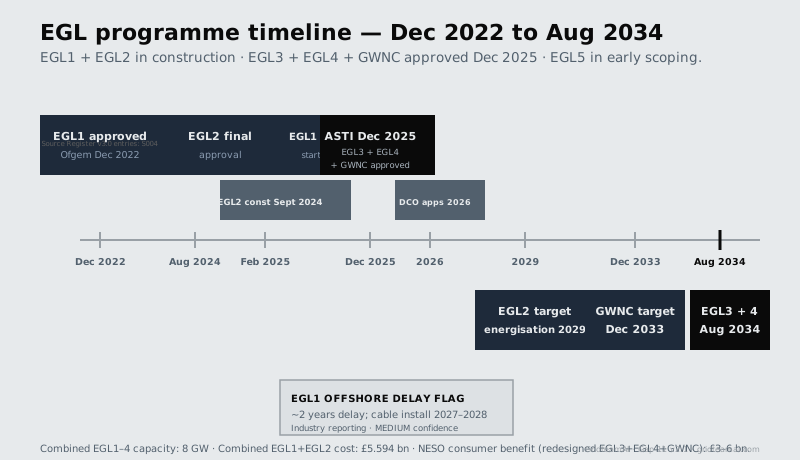
Figure 1 · The programme timelineOfgem · 2022–2034
From EGL1 approval (Dec 2022) to EGL3/EGL4 operations (Aug 2034).
EGL1 + EGL2 in construction; EGL3 + EGL4 + GWNC approved Dec 2025; EGL2 targets 2029, GWNC December 2033, EGL3 + EGL4 August 2034. EGL1 offshore installation runs ~2 years late at 2027–2028.
Fig. 1 / Section 1
Navy blocks mark approvals and targets; the ink blocks are the Dec 2025 ASTI anchor and the Aug 2034 destination. The EGL1 offshore delay is flagged at MEDIUM confidence.
Quarterly Sector Report · Gap 112 · Twelve findings · p. 10
09 — 102 · Six findings · 01 – 04 · 2×2 grid
2 · Twelve findings on the EGL programme10
2 · Twelve findings on the EGL programmeQ3 2028 · forward-looking
Twelve findings. Each carries a confidence level.
HIGH — anchored to a verified Ofgem or transmission-owner published position. MEDIUM — Ofgem / NESO direction of travel with material implementation questions open. LOW — GridteamAI inference where the source supports direction but not magnitude or pacing.
Findings 01 – 12 · summary
01EGL1 and EGL2 have cleared regulatory approval and are in construction.
02EGL3 and EGL4 moved from concept to early-investment approval — the December 2025 milestone.
03The technology architecture is consistent and standardised across the series (525 kV VSC).
04The route geography reveals a structural triangulation across the Scottish coast.
05The cost trajectory reveals a £3.4 bn-to-£5.594 bn escalation on EGL1+EGL2.
06The supply chain is consolidated around a small number of credibly-capitalised firms.
07The consenting architecture is structurally hybrid across Scotland and England.
08ASTI is delivering procurement acceleration but is being stress-tested by scale.
09EGL5 is the next scoping question and shapes the post-2030 trajectory.
10The EGL programme interlocks with RIIO-T3 and the wider transmission ambition.
12The Q3 2028 review picture will be a construction-and-consenting story.
Findings 01 – 09 follow in detail · pp. 10 – 12 · 10 – 12 carried on the Section 6 matrix
Quarterly Sector Report · Gap 112
112 · Findings 01 – 03
2 · Findings 01 — 03In construction · the Dec 2025 milestone · the technology
Finding 01 · HIGH
EGL1 and EGL2 have cleared regulatory approval and are in construction.
EGL1 received Ofgem approval in December 2022 under ASTI, with construction commencing 13 February 2025; EGL2 received final approval in August 2024 and began construction in September 2024, targeting energisation in 2029. EGL1’s offshore construction is delayed by ~2 years, with cable installation now scheduled 2027–2028. The structural significance is that the programme has cleared the regulatory hurdle and is in the operational delivery phase — Q3 2028 status turns on execution, not further regulatory decisions.
Finding 02 · HIGH
EGL3, EGL4 and GWNC moved to early-investment approval — three schemes, not two.
Ofgem's December 2025 decision approved early construction funding for three schemes — EGL3 (8% of updated forecast cost), EGL4 (13%) and the Grimsby West–Norfolk Connection, a separate 75-mile 400 kV onshore link. National Grid, SSE and Scottish Power invest in the two subsea cables; both terminate at Anderby Creek, Lincolnshire. Target operations are August 2034 for EGL3/EGL4 and December 2033 for GWNC. DCO applications are due to the Planning Inspectorate in 2026.
Finding 03 · HIGH
The technology architecture is consistent and standardised across the series.
EGL1, EGL2, EGL3 and EGL4 are each rated 2 GW (bi-pole), 525 kV DC, using Voltage Source Converter (VSC) technology on Cross-Linked Polyethylene (XLPE) cables, with mass-impregnated (MI) as fall-back — one technology platform across 8 GW of nameplate. Standardisation lowers supply-chain risk, lets operational capability accumulate across the fleet, and underwrites UK domestic supply-chain investment that pays back over multiple schemes plus EGL5 and beyond.
 GridteamAI