UK Solar
Farms 2028.
From 20 GW operational to a 45–47 GW target by 2030, a 72-action Solar Roadmap, and AR7a’s record 4.9 GW allocation.
This is part of the paid GridteamAI Quarterly Sector Report.
£295 single volume · £995/yr annual · Team £2,495 · Enterprise £4,995 · Corporate £9,995. Secure checkout coming soon; email to purchase today.
From 20 GW operational to a 45–47 GW target by 2030, a 72-action Solar Roadmap, and AR7a’s record 4.9 GW allocation.
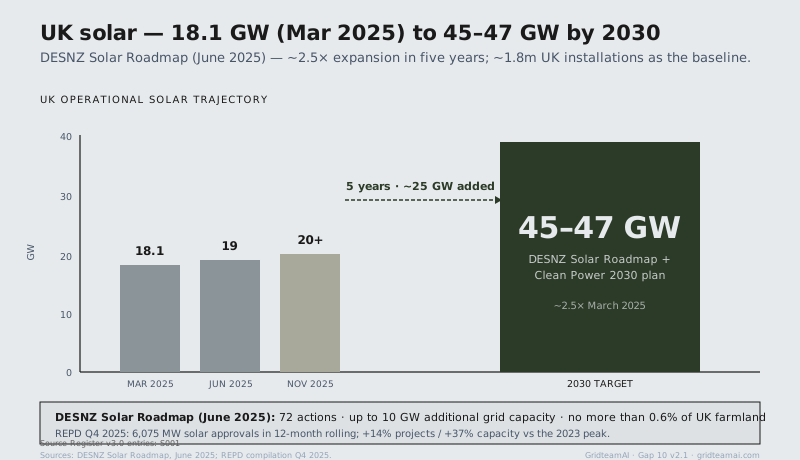
UK solar passed 20 GW operational in November 2025, from 18.1 GW in March. The DESNZ Solar Roadmap (June 2025) sets a 45–47 GW GB ambition by 2030 — about 2.5× the March 2025 baseline — with grid capacity for up to 10 GW more.
The Roadmap sets out 72 actions across planning, grid, supply chain, finance and adoption. The NSIP solar threshold rose from 50 to 100 MW (England only) on 31 December 2025 — the same Order that raised onshore wind (Gap 09).
AR7a (10 February 2026) cleared a record 4,905 MW of solar across 157 projects at £65.23/MWh — a 13.03% saving. England-dominant at 86.6%; West Burton (480 MW) the largest cluster. REPD shows 6,075 MW approved in 12 months — +37% on the 2023 peak.
Solar+BESS co-location is normalising for connection-capacity efficiency; the land-use debate is consolidating around the Roadmap’s 0.6%-of-farmland commitment. AR8 (2027) is the next major round; the REPD pipeline keeps maturing toward the 2030 target.
The shape of this volume. Section 1 sets out the headline figures. Section 2 develops twelve findings, each confidence-annotated. A chapter-weight pull at p. 14 anchors the argument. Section 3 sets out the solar architecture — fleet, pipeline, CfD, Roadmap. Section 4 covers the 72 actions and AR7a solar detail. Section 5 covers geography, solar+BESS and land use. Section 6 makes recommendations, with a one-page tear-out at p. 25.
Past 20 GW in November 2025; 72-action Roadmap; up to 10 GW additional grid capacity; no more than 0.6% of UK farmland.
The bars climb from 18.1 GW (Mar 2025) to the 45–47 GW 2030 ambition — about 2.5×. Moss marks the 2030 target; 20 GW was passed in November 2025.
HIGH — verified against a NESO, Ofgem, DNO or DESNZ primary source. MEDIUM — named UK industry coverage cross-referenced to a primary source. None is forward-looking opinion unless framed as such.
Findings 01 – 12 · summary
Findings 01 – 09 follow in detail · pp. 10 – 14 · 10 – 12 summarised on the matrix
18.1 GW (March 2025) → 19 GW (June) → 20+ GW (November 2025), across ~1.8 million installations. Solar has moved from the scaling category into the structural backbone of UK clean power; combined with growing BESS (Gap 06) and DSR (Gap 12), its system-integration value is expanding. Projected Q2 2028 fleet: 28–32 GW.
Per the DESNZ Solar Roadmap (June 2025): 45–47 GW of all solar types by 2030, with grid capacity for up to 10 GW more should the system need it. Against the 18.1 GW March 2025 baseline this is ~2.5×, needing roughly 27 GW of net additions in five years. Solar is the second-largest single 2030 technology after offshore wind.
4,905.01 MW across 157 projects (72 delivering 2027/28, 85 in 2028/29) at £65.23/MWh (2024 prices) — a 13.03% saving on the £75 Administrative Strike Price. The largest single UK solar CfD allocation to date, and the structural anchor of the 45–47 GW trajectory.