The Onshore Wind Reset Decode · Executive summary05
00 · Executive Summary
A two-page brief
A decade-long English ban, reset in eighteen months — and a near-doubling to chase by 2030.
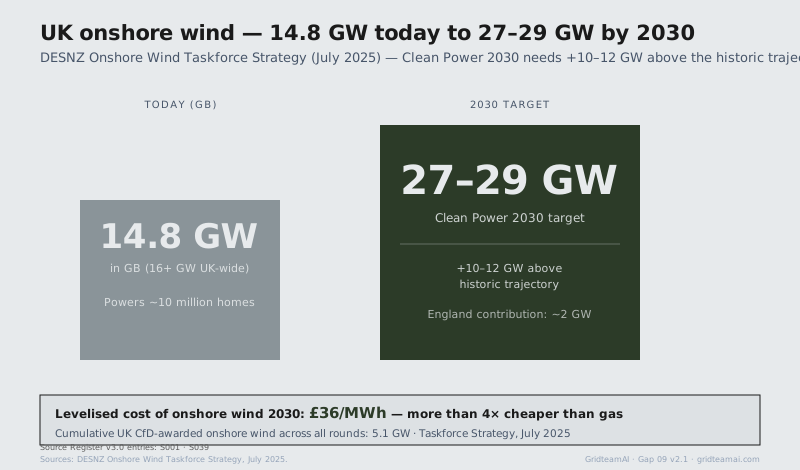
UK onshore wind capacity is 14.8 GW in GB (over 16 GW UK-wide). The Clean Power 2030 target is 27–29 GW — a near-doubling needing 10–12 GW above the historic trajectory, with England contributing around 2 GW.
The NPPF reset ran in two stages: the 8 July 2024 joint policy statement removed footnotes 57 and 58; the February 2025 revision codified it. The NSIP 100 MW threshold came into force in England on 31 December 2025. The DESNZ Taskforce Strategy (July 2025) sets out 42 actions across six themes.
AR7a (10 February 2026) cleared the first material post-reset allocation: 1,306 MW across 28 projects at £72.24/MWh — a 21.48% saving on the £92 cap. The split is starkly Scottish: Scotland 83.6%, Wales 14.2%, England just 2.2% (two projects), reflecting pipeline-maturity lag, not a structural ceiling.
The Q3 2027 picture
Onshore wind at £36/MWh levelised by 2030 is more than 4× cheaper than gas. The reset supports up to 45,000 jobs (from ~19,700 today) and ~£70m/year of additional rural investment. AR8 (expected 2027) is the next test of whether English allocations scale.
The shape of this volume. Section 1 sets out the headline figures. Section 2 develops twelve findings, each confidence-annotated. A chapter-weight pull at p. 14 anchors the argument. Section 3 sets out the reset architecture — NPPF, NSIP, Taskforce, CfD. Section 4 covers the 42 actions and Scottish dominance. Section 5 covers communities, repowering and supply chain. Section 6 makes recommendations, with a one-page tear-out at p. 25.
Executive summary · ends1 · The headline figures · p. 07
 GridteamAI