RIIO-ED3 Business Plan Decode · Executive summary05
00 · Executive SummaryA two-page brief
ED3 is a structural reset across five dimensions at once.
The RIIO-ED3 SSMD, published 21 May 2026, sets the methodology against which five GB DNOs — controlling fourteen licence areas — submit final business plans in December 2026, Ofgem issues Draft Determinations in summer 2027, and the price control operates from 1 April 2028 to 31 March 2033.
Five structural changes against ED2 stand out: Build-and-Flex becomes a mandatory first-step obligation; tRESPs become a common planning input across all five DNOs; a hybrid delivery-accountability framework constrains capex discretion; a new CRMI framework introduces statutory climate-resilience reporting; and the financial package compresses the equity risk-reward envelope.
The consequence: DNOs enter business planning with a tighter, more delivery-conditional framework than ED2, in a period when they must materially scale capex for the electrification of heat, transport and industry.
GridteamAI · Quarterly Sector Report · Gap 05UK
06Executive summary · continued
The window is short, and the framework it will be assessed against is novel.
Draft business plan data templates are due July 2026; final business plans December 2026. Ofgem issues Draft Determinations in summer 2027; the control period runs 1 April 2028 to 31 March 2033. The CMA's September 2026 GD3 appeal decision will materially shape the cost-of-equity and cost-assessment positions at Draft Determinations.
For non-DNO stakeholders, four implications follow
Flexibility-market revenue is now structurally embedded, not procurement-cycle dependent. The connection conversation for large loads has been reframed by a new “larger connections” incentive package. The consumer-vulnerability framework has been strengthened around electrification. And the CMA's GD3 ruling will shape ED3 Draft Determinations.
The shape of this volume. Section 1 sets out the SSMD headline figures. Section 2 develops ten findings, each confidence-annotated. A chapter-weight pull at p. 14 anchors the argument. Section 3 decodes the five-element ED3 architecture. Section 4 maps the five GB DNO groups. Section 5 decodes the 4.35% allowed return. Section 6 sets out stakeholder implications, with a one-page tear-out at p. 26.
Executive summary · ends1 · The headline figures · p. 07
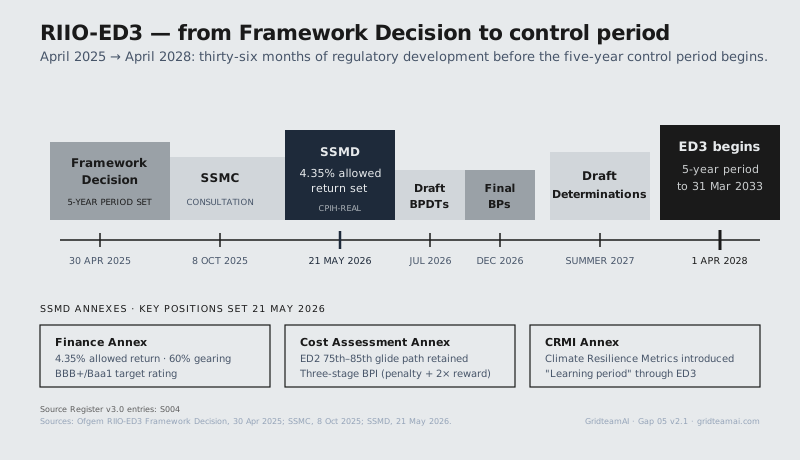
09 · FIG. 13 · ED3 timeline · restyled -v2
1 · The headline figures09
Figure 1 · From Framework Decision to control periodOfgem · 2025–28
Thirty-six months of regulatory development before ED3 begins.
Framework Decision (Apr 2025) → SSMC → SSMD (21 May 2026, where the 4.35% return is set) → BPDTs → final business plans → Draft Determinations → control-period start (1 Apr 2028).
Fig. 1 / Section 3
The SSMD milestone (cobalt) is where the 4.35% return is set; the ED3-start is the ink destination. The three annex cards carry the Finance, Cost Assessment and CRMI positions.
Quarterly Sector Report · Gap 052 · Ten findings · p. 10
09 — 102 · Six findings · 01 – 04 · 2×2 grid
2 · Ten findings on what ED3 requires10
2 · Ten findings on what RIIO-ED3 requiresSSMD · 21 May 2026
Ten findings. Each carries a confidence level.
HIGH — anchored to a verified Ofgem SSMD position. MEDIUM — Ofgem-stated direction with material points open at Draft Determinations. LOW — GridteamAI inference where the source supports direction but not magnitude.
Findings 01 – 10 · summary
01Build-and-Flex has moved from optional to mandatory first-stage obligation.
02The tRESP is the new common planning input — and the new external check.
03The financial-parameter package compresses the equity risk-reward envelope.
06Cost-assessment modelling is in active development, with drivers still open.
07The connections incentive framework has been restructured around larger-vs-smaller.
08The BPI and TIM reward early ambition with tighter delivery linkage.
09Customer-vulnerability incentives have been strengthened around electrification.
10The Interruptions Incentive Scheme is retained but acknowledged to need refinement.
Findings 01 – 09 follow in detail · pp. 10 – 12 · 10 carried on the Section 6 matrix
Quarterly Sector Report · Gap 052
112 · Findings 01 – 03
2 · Findings 01 — 03Build-and-Flex · the tRESP · the finance package
Finding 01 · HIGH
Build-and-Flex has moved from optional to mandatory first-stage obligation.
Under ED2, DNOs could elect to substitute flexibility for reinforcement, the trade-off mediated by the TIM. Under ED3 the SSMD makes flexibility the first stage of optioneering: DNOs must systematically assess flexibility before committing to physical reinforcement, and it is separately funded through distinct allowances. The optioneering record becomes auditable; the commercial standing of aggregators, BESS owners and DSR providers is elevated. Open at Draft Determinations: how flexibility deployed in place of reinforcement is treated under the Output Delivery Mechanism.
Finding 02 · HIGH
The tRESP is the new common planning input — and the new external check.
NESO published the transitional Regional Energy Strategic Plans in January 2026. The SSMD assigns them a structural role as the common planning input for all five DNOs, with each DNO's application subject to independent NESO assurance from December 2026. This is the first consistent exogenous planning baseline in UK distribution regulation — it removes the ED2 demand-driven post-modelling adjustment (in principle) and moves the question from “is your forecast reasonable?” to “is your application of the tRESP defensible?”
Finding 03 · HIGH
The financial-parameter package compresses the equity risk-reward envelope.
The SSMD Finance Annex sets an indicative 4.35% CPIH-real allowed return (cost of equity 6.08%, cost of debt 5.42%, 60% gearing, BBB+/Baa1 target). Ofgem rejected industry proposals to broaden the investability test or raise the dividend-yield and equity-issuance assumptions. SSE's same-day statement flagged the calibration. With the CMA's September 2026 GD3 ruling able only to tighten cost-of-equity, the 4.35% is best read as a ceiling, not a floor.
 GridteamAI