£295 single volume · £995/yr annual · Team £2,495 · Enterprise £4,995 · Corporate £9,995. Secure checkout coming soon; email to purchase today.
GridteamAI · The Gap Series · No. 04
The Data Centre Build-out Gap — A GridteamAI position on UK data centre demand, where it lands, and what the country has to choose
Series consistency · same system as No. 01 + No. 02
A4 · 210 × 297 mm · 3 mm bleed (not shown)
UK English · 2026 edition · v1.0
FRONT MATTERi · Cover · ink · full bleed
GridteamAI
The Gap Series
Publication No. 04
A Quarterly Sector Report
by GridteamAI
UK · Data Centre · Build-out · AI Growth ZonesUnited Kingdom · Q4 2026
The Data Centre Build-out Gap.
A GridteamAI position on UK data centre demand, where it lands, and what the country has to choose.
gridteamai.com · book@gridteamai.comFirst editionPremium digital edition
05 — 06Executive summary · spread
The Data Centre Build-out Gap · Executive summary05
00 · Executive SummaryA two-page brief
AI is moving British data centres out of London.
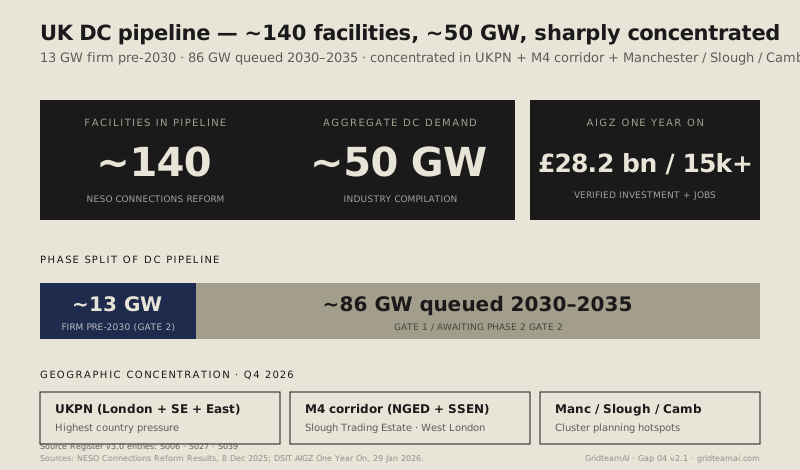
Around 140 data-centre facilities sit in the NESO connections pipeline. They aggregate to roughly 50 GW of demand. About 13 GW is firm enough to receive a Gate 2 pre-2030 offer. A further 86 GW is queued for the 2030–2035 window.
The Department for Science, Innovation and Technology is using the AI Opportunities Action Plan, AI Growth Zone designations, and a reformed grid-allocation mechanism to deliberately route hyperscale demand away from London and the South East, where headroom is exhausted, and toward Oxfordshire, South Wales, North Wales and the North East of England, where headroom remains.
The £14 bn pipeline announced in early 2026 under the Action Plan is the largest single intervention in UK digital infrastructure policy of the decade. Combined with the December 2025 NPPF consultation that places AI Growth Zones into local development plans, and the reformed NESO connections regime that prioritises strategic-demand projects, the framework now exists to materially shift where the next 50 GW of UK data-centre capacity gets built.
GridteamAI · The Gap Series · 04UK
06Executive summary · continued
The constraint that nobody planning permission can fix is water.
84% of proposed UK data centres are planned for water-stressed areas. The Environment Agency is warning of drought conditions in 2026. The DSIT-commissioned water-use report (August 2025) found 65% of England's data-centre water consumption is concentrated in six facilities; another finding is that 51% of surveyed sites are already deploying waterless cooling — which is also rising precisely where AI / GPU compute is going.
Water is, in 2026 and onward, the single most likely planning rejection ground for new hyperscale sites.
The volume's argument
By the end of 2027 the UK data-centre map will look meaningfully different. Developers who position into the AI Growth Zones now, accept that London and the South East are full, and engineer for water as a planning input rather than an afterthought, will be the firms still building in 2030.
The shape of this volume. Section 1 sets out the headline figures. Section 2 sets out six findings, each supported by a primary source. A chapter-weight pull at p. 14 anchors the argument. Section 3 sets out the AI Growth Zone framework. Section 4 maps the seven UK regional hotspots. Section 5 isolates the water question. Section 6 makes nine concrete recommendations to developers, the supply chain and buyers, with a one-page tear-out at p. 26.
Executive summary · ends1 · The headline figures · p. 07
~140 facilities, ~50 GW of demand — but only ~13 GW is firm before 2030.
The phase split is the whole argument: a small connectable-now tranche against an 86 GW queue, concentrated in three corridors.
Fig. 1 / Section 1
The connectable-now tranche (indigo) is roughly one-seventh of the queued total. Reads against the stat tiles on p. 07.
The Gap Series · 042 · Six findings · p. 10
09 — 102 · Six findings · 01 – 04 · 2×2 grid
2 · Six findings on UK data-centre build-out10
2 · Six findings on UK data-centre build-outQ4 2026
Six findings. Each dated. Each supported by at least one primary source.
None is forward-looking opinion unless explicitly framed as such.
Findings 01 – 06 · summary
01AI is moving British data centres out of London.
02£14 bn is on the table.
03The NPPF is being rewritten with data centres in mind.
04Water is now the constraint, not power.
05Waterless cooling is becoming the default.
06The grid-allocation mechanism now favours strategic demand.
Each finding follows in detail · pp. 11 – 13
The Gap Series · 042
112 · Findings 01 – 02
2 · Findings 01 — 02The pull · the policy
Finding 01 · The pull
AI is moving British data centres out of London.
Industry reporting throughout April 2026 (Resultsense, The Register) confirms a measurable shift: AI workloads need power that London cannot deliver. The DSIT AI Growth Zone Delivery Unit is actively routing developers and investors toward designated zones in Oxfordshire, South and North Wales and the North East. Three of the four initial AI Growth Zones sit outside the historic UK data-centre belt entirely. The geography is changing in real time, and 2027 build-starts will materially differ from 2025's.
Sources · DSIT AI Growth Zone Delivery Unit · Resultsense · The Register, April 2026
Finding 02 · The capital
£14 bn is on the table.
The UK AI Opportunities Action Plan (Cabinet Office / DSIT, 2026) has brought forward an aggregate £14 bn of announced data-centre investment. This is reported by DCD and corroborated in independent legal analysis. The figure dwarfs every previous UK digital-infrastructure intervention and constitutes the policy commitment behind the AI Growth Zone framework. Bidders who treat the announcement as marketing rather than capital commitment will be left behind by the firms who do not.
 GridteamAI